
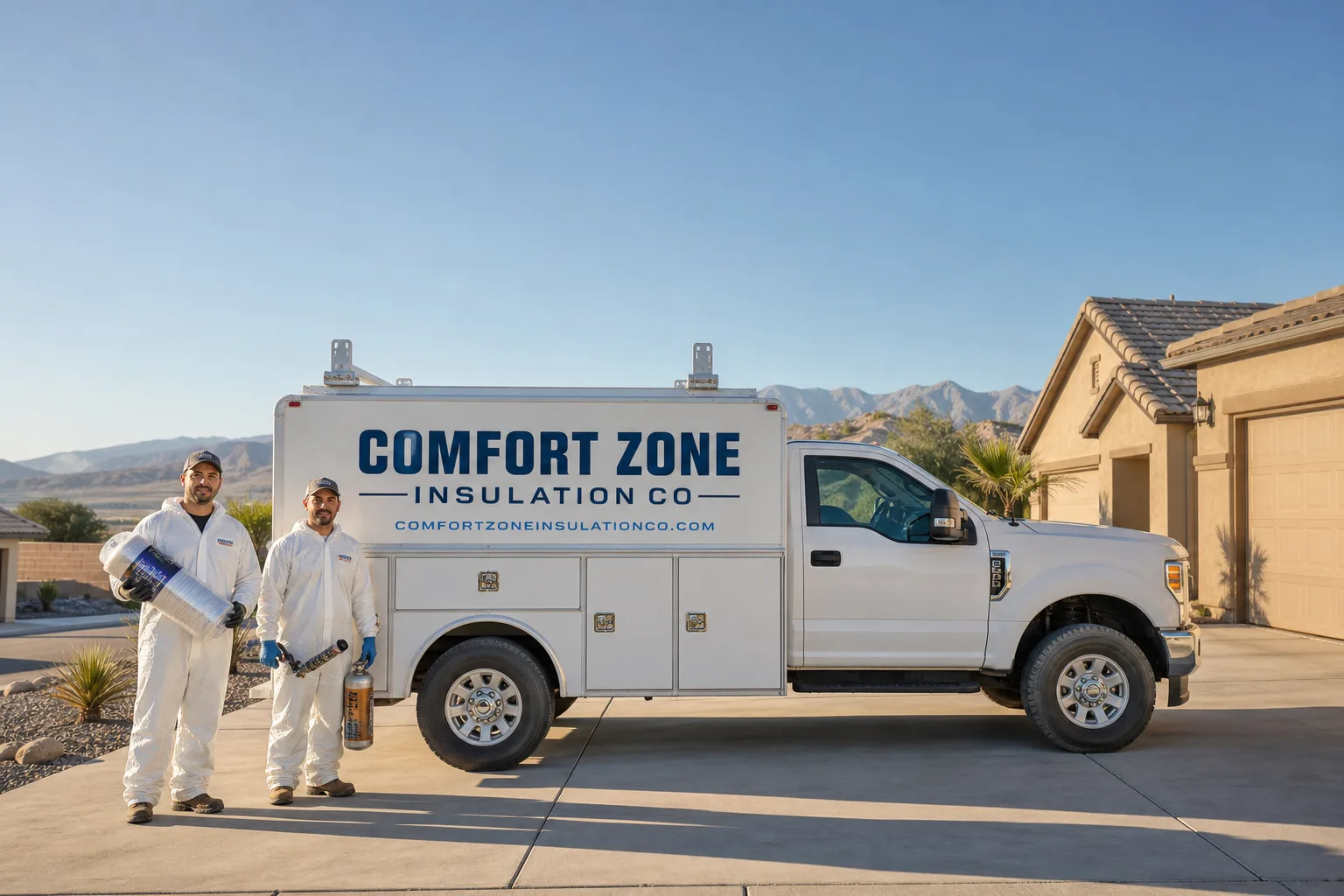
Fast, Reliable Spray Foam Insulation Across Pasadena
Spray foam insulation in Pasadena typically costs $3.50 – $7.50 per square foot installed, with most attic roof-deck projects landing between $4,800 and $11,000 depending on square footage and foam type. Same-week scheduling is usually available for homes in 91103, 91104, 91106, and surrounding corridors. Comfort Zone Insulation Co has been working in Pasadena’s older housing stock long enough to know exactly what those pre-war walls and shallow attics need. Call (855) 341-7856 for a free estimate from Noel Carrasco’s team, and we’ll give you an honest read on what your house actually requires before anyone opens a single can of foam.
Here’s what you need to know up front: closed-cell foam is the better call for Pasadena roof decks and detached workshops, open-cell works well for interior wall cavities and sound control, and most pre-war homes here need air sealing before they need more R-value. We’ll walk through each of those below, with real numbers and the reasoning behind them.
Why Comfort Zone Insulation Co Is Pasadena’s Preferred Spray Foam Insulation Company
We install insulation and nothing else. That matters in Pasadena because the housing stock here is unforgiving. Craftsman bungalows from the 1910s through the 1930s, Spanish Colonial Revivals from the 1920s, mid-century ranches east of Hill Avenue, and the larger hillside homes in 91105 all behave differently when you introduce spray foam. A general contractor who does insulation as a sideline won’t know that a lath-and-plaster wall needs different prep than drywall, or that a balloon-frame cavity runs uninterrupted from crawl space to attic and will pull foam into places you didn’t intend. Our crews have worked hundreds of these houses, and we’ve made the mistakes so you don’t have to pay for them.
Noel Carrasco started Comfort Zone Insulation Co because he saw too many Pasadena homeowners getting sold whichever product happened to be on the truck that week. We carry eight manufacturer lines, including Owens Corning, Johns Manville, and Demilec, so the material is chosen for your house, not for our inventory. When you call, you’re getting a diagnostic conversation first. Attic first. Then we talk products and pricing.
We send crews to Pasadena multiple times per week, and our San Bernardino base means we’re not fighting LA traffic from the west side to get to you. Typical response time for an estimate visit is 2 to 3 business days. Emergency work, like a roof deck that’s sweating during a Santa Ana event, can often be scheduled within the week.
Closed Cell Spray Foam Insulation in Pasadena
Closed Cell Spray Foam Insulation is the workhorse for Pasadena’s unvented attics, roof decks, and detached workshops. It cures rigid, adds structural strength, and creates a vapor barrier at roughly 2 inches, which matters when the overnight temperature drops 30 degrees from the afternoon high and condensation wants to form inside your attic assembly. Most roof-deck applications in Pasadena run $5.50 – $7.50 per square foot installed at 3 to 4 inches of depth. Detached garages and workshops, which we’ll get to below, fall in a similar range depending on whether the walls are framed or block.
Roof Deck Sealing for Older Homes
In the 91103 and 91104 corridors, many attics sit under mature oaks and feel deceptively cool all day. The shade hides what’s actually happening: your roof deck is still absorbing direct sun on the east and west exposures, and that heat radiates into the attic space continuously. Closed-cell foam applied directly to the underside of the roof deck stops that heat transfer at the source. It also blocks the dust and ember intrusion we see during dry Santa Ana wind events, which is a real concern for older homes with gaps at the eaves.
Detached Workshops and Garages
A detached structure in Pasadena’s 91107 ranch tracts or the larger lots east of the Rose Bowl almost never has a conditioned envelope. That means the slab sweats, tools rust, and the space becomes unusable from June through September. Closed-cell foam on the walls and roof deck changes that. It also handles the oversized garage doors common in these neighborhoods by reducing the thermal load, so the opener and springs aren’t fighting a 15-degree temperature differential every time you cycle the door.
Open Cell Spray Foam in Pasadena
Open Cell Spray Foam is the right choice for interior wall cavities, crawl space ceilings, and anywhere sound control matters more than maximum R-value per inch. In Pasadena, a typical open-cell wall cavity job runs $3.50 – $5.50 per square foot installed. It expands aggressively, which makes it a strong fit for the irregular framing we find in balloon-frame and lath-and-plaster houses where stud bays aren’t consistent. Open-cell is also the product we recommend for interior partition walls in homes where a home office or media room sits adjacent to living space, since it dampens sound far better than closed-cell.
Wall Cavity Retrofits in Older Homes
When a Pasadena homeowner wants to insulate the exterior walls of a 1920s Craftsman without tearing out the lath and plaster, open-cell spray foam is often the best option when we can access the cavities from the attic or basement. It moves through irregular spaces well and creates an air seal, which is really what those old walls need. The catch: if those walls are open during a remodel, we typically recommend closed-cell at 2 inches for the vapor control, and we’ll walk you through why before you commit.
Foothill Homes with Moisture Concerns
Homes in the foothill edges of 91105 and the northern parts of Altadena see more overnight moisture than the flatlands. Open-cell foam is vapor-permeable, which means it doesn’t trap moisture in the wall assembly. That’s the reason we use it in crawl space rim joists and ceiling applications where airflow from the soil is a factor. We’ll be honest about when open-cell is the wrong call, too. Shallow roof decks with no ventilation channel generally get closed-cell, not open-cell.
Trusted Brands We Service in Pasadena
We’re authorized to install products from eight industry brands, and the ones that come up most often in Pasadena are Owens Corning for attic systems, Demilec and Icynene for spray foam, and Rockwool for customers who want a mineral-based option with fire resistance. Johns Manville and Knauf products round out the blown-in and batt side of things. What that means for you is straightforward: we don’t have a quota to hit on any single brand. When you call, we diagnose the house first and then pick the material that fits the structure, your budget, and your comfort priorities. Parts and material restocking for Pasadena jobs happen weekly, so changes mid-project don’t stall the schedule.
Common Spray Foam Insulation Problems We See in Pasadena Homes
- Foam delamination over dusty attic lumber. Unvented attics in Pasadena’s pre-war homes collect decades of fine silt and dust, and spray foam applied over that layer will peel away within a season or two. In the 91103 and 91104 areas, we see this constantly on homes that had a cheap spray job done years ago. Proper prep means vacuuming or mechanically cleaning the deck before application, and it’s non-negotiable.
- Condensation from thin open-cell on shallow roof decks. Roof pitches in Spanish Colonial Revivals and some Craftsman homes are shallow enough that 3 inches of open-cell foam won’t hit the condensation control you need during cool foothill nights. The fix is usually a thicker closed-cell application or a vented assembly, and we see the telltale water stains in the sheathing when we inspect.
- Missing ignition barriers in detached workshops and garages. Exposed spray foam in an occupied workshop or garage is a code issue and a safety problem. Every detached workshop job we do in Pasadena includes either an intumescent coating applied by a certified professional or drywall over the foam. This is not an optional upgrade.
- Shade-masked attic heat gain. We mentioned this earlier, but it’s the most common diagnostic miss in Pasadena. Homeowners near the Arroyo Seco or under mature camphors and coast live oaks assume the shade is doing the work. The roof deck is still capturing direct sun on exposed exposures, and the attic is still cycling 25 to 35 degrees between night and afternoon. Spray foam on the deck fixes what the trees can’t.
Pricing for Spray Foam Insulation in Pasadena, CA
Let’s put numbers on this. For a typical 1,500-square-foot attic roof deck in a Pasadena bungalow, closed-cell spray foam at 3 inches runs $8,250 to $11,250 installed, including prep and clean-up. Open-cell wall cavity injection in a similar house typically lands between $3,500 and $5,500 for all exterior walls, depending on access from the attic and any lath-and-plaster complications. Detached workshop and garage projects fall between $4,000 and $8,500 for walls and ceiling, with oversized structures pushing higher. What moves the price: foam thickness, surface prep requirements, access difficulty, and whether the existing insulation needs removal first. Estimates are free, and the number we quote is the number you’ll pay, no re-negotiation after we open the walls. Call (855) 341-7856 and Noel’s team will get you scheduled.
We Also Serve Cities Near Pasadena
Our Spray Foam Insulation crews cover all of Pasadena’s ZIP codes and regularly work in South Pasadena, San Marino, Altadena, and East Pasadena. If you’re in any of those areas and dealing with an uninsulated attic, a drafty workshop, or rooms that never hold temperature, Pasadena is our home base for the western San Gabriel Valley, and we’re usually in the area within a few days of your call.
Serving Pasadena, CA — Our Local Coverage Area
We’re based in the Pasadena area and know this community well. Use the map below to see our service coverage — if you’re nearby, we can almost certainly help.
FAQs About Spray Foam Insulation in Pasadena
Lath-and-plaster walls change how we access wall cavities and where we apply foam. The plaster keys that grip the lath are fragile, so we can’t simply drill and inject like we would with drywall. We typically access cavities from the attic above or the crawl space below, and we work slowly around the irregular stud bays and diagonal bracing that are common in 1900s-1940s framing. The plaster itself is a decent air barrier in some walls, which means we may recommend foam in the attic and crawl space instead of the walls, depending on where the actual heat loss is. Call (855) 341-7856 and we’ll tell you what your house actually needs, not what’s easiest to sell.
Yes, spray foam helps in three ways during Santa Ana events. First, closed-cell foam seals the gaps at eaves, gable ends, and around framing that let wind-driven dust and embers into your attic. Second, it stabilizes attic temperatures so your HVAC isn’t fighting a 40-degree swing while the wind strips heat from the building envelope. Third, foam on the roof deck holds the structure together better under the negative pressure high winds create against your roof. We’ve seen the difference in homes along the 210 corridor after recent wind seasons.
Closed-cell foam on the walls and roof deck is the standard recommendation for detached workshops in 91107 and similar ranch-tract neighborhoods. These structures are usually uninsulated, slab-on-grade, and built with minimal framing depth. Closed-cell gives you structural rigidity, vapor control, and the highest R-value per inch you can get in a 2×4 or 2×6 wall. It also makes the space usable year-round without a dedicated furnace, which is what most workshop owners actually want. We recently spray-foamed the detached workshop of a 1920s Craftsman in the 91103 corridor near the Rose Bowl, where the homeowner’s heavy steel door and oversized garage required a tighter envelope to keep the space usable year-round. After sealing the roof deck with closed-cell foam and air-sealing the door frame, the workshop held temperature through a Santa Ana wind event and the homeowner reported the overhead door cycled smoothly without the previous draft-induced strain.
The oaks don’t affect the foam directly, but they affect the prep and scheduling. Mature coast live oaks and camphors drop debris into gutters and roof valleys, and that organic material can sit against the eaves and hold moisture. We clear and clean the roof-line area before spraying, and we account for the fact that shaded roof sections may have moss or debris that needs removal before foam can bond. Oak shade is also the thing that makes Pasadena attic heat gain counterintuitive, as we covered above. The shade cools the attic air but not the roof deck, and that’s where the real heat transfer happens.
Open-cell is suitable for interior wall cavities, sound control, and crawl space applications in Pasadena, but it’s not the best choice for roof decks in this climate. The day-night temperature spread between Sierra Madre foothill nights and hot San Gabriel Valley afternoons means roof decks need the vapor control and condensation resistance that closed-cell provides. Open-cell is air-permeable and vapor-permeable by design, which is exactly what you want in a wall where moisture needs to dry, and exactly what you don’t want in an unvented attic where cool night air is meeting warm interior air. For open-cell roof applications, we’d typically recommend a vented assembly or a hybrid system, and we’ll explain the tradeoffs before you commit either way.
Written by Noel Carrasco, Owner at Comfort Zone Insulation Co, serving Pasadena and the San Gabriel Valley with insulation expertise across eight major brands.