
Last updated October 30, 2026
Insulation Permits, Codes & Inspections in CA: What You Need to Know
California’s approach to insulation regulation changed more in the last code cycle than it did in the previous two decades combined. When the 2022 Energy Code took effect, it introduced a continuous air barrier requirement that quietly invalidated installation methods contractors had used for years. If you’re planning insulation work in San Bernardino, you’re operating under rules most online guides haven’t caught up to. This guide walks through the actual permit triggers, the Title 24 forms that matter, what Climate Zone 10 demands of your ceiling and walls, and what happens if unpermitted work surfaces during a sale. For more guides & resources, see our blog. No generalities. Just the specifics the code actually requires.
Quick Answer
Most insulation work in California does not require a standalone permit if it’s a like-for-like replacement or installed during new construction under the builder’s permit. However, any insulation installed in a conditioned space must meet California’s Title 24 energy code, documented via CF1R and CF3R forms, and pass a building department inspection when a permit applies. In San Bernardino, the key threshold is change of scope: adding insulation where none existed, converting unconditioned space to conditioned, or altering the building envelope typically triggers permit requirements.
Table of Contents
- When a Permit Is Actually Required in California
- San Bernardino-Specific Permit Variations
- Title 24 CF1R and CF3R Forms: What They Are and Why You Should Have Copies
- The 2022 Air Barrier Mandate: What It Means for Every Insulation Type
- Climate Zone 10 R-Value Requirements in San Bernardino
- What Inspectors Actually Look For During an Insulation Inspection
- What Happens When Unpermitted Insulation Is Discovered
- Common Mistakes to Avoid
- When to Call a Professional
- Frequently Asked Questions
When a Permit Is Actually Required in California
California building permits are governed by the California Building Code (CBC) and the California Energy Code (Title 24, Part 6). The California Energy Commission updates Title 24 on a rolling three-year cycle. The standards currently enforceable statewide are the 2022 Energy Code, which took effect January 1, 2023. The 2025 standards are published and will take effect January 1, 2026, but as of this writing, inspections still run against the 2022 baseline.
Here’s the practical breakdown of when insulation work triggers a permit:
- New construction or additions: Always permitted. Insulation is part of the building envelope, documented on the CF1R, and verified on the CF3R before final inspection.
- Converting unconditioned to conditioned space: Always permitted. Turning a garage, attic, or crawl space into living area changes the building’s conditioned volume and square footage, which triggers plan review and energy compliance.
- Same-area insulation replacement (like-for-like): Generally exempt from a standalone permit. If you’re removing old fiberglass batts and installing new batts of equivalent or higher R-value, most California jurisdictions, including San Bernardino, treat this as maintenance. No permit required.
- Adding insulation where none existed: This is a permit trigger in many cities. If your attic has zero insulation and you want to add R-38 blown-in, you’re altering the building envelope’s thermal performance. San Bernardino’s building department historically treats this as requiring a permit, though enforcement varies by inspector.
- Insulation installed with other work: If a permit is pulled for a roof replacement, window retrofit, or wall re-siding, the insulation portion falls under that permit’s scope and must meet current code rather than the code in effect when the home was built.
The distinction that matters: California code doesn’t exempt insulation work because it’s “just insulation.” It exempts maintenance that restores a system to its original condition. Upgrade or change the system, and you may be in permit territory. A contractor who tells you “insulation never needs a permit in California” is oversimplifying. A contractor who pulls a permit for every insulation job may be padding the invoice. The right answer depends on scope. If you’re near San Bernardino, the Comfort Zone Insulation Co home page covers how we approach scope determination for local jobs.
San Bernardino-Specific Permit Variations
San Bernardino sits in San Bernardino County, but the city itself operates its own building and safety division. What applies in unincorporated county areas near Devore or Muscoy won’t necessarily match what applies at a city address near Cal State San Bernardino or in the Verdemont neighborhood. This matters because California gives local jurisdictions enforcement discretion on certain residential energy provisions.
Three variations we see regularly in San Bernardino:
- Attic insulation replacement with air sealing: The city tends to interpret the 2022 air barrier mandate strictly. If your insulation project includes air sealing the attic floor (recessed can light covers, top plate sealing, plumbing penetrations), the inspector may require documentation showing the air barrier work was completed to code even if the insulation itself is a like-for-like replacement. This is a positive shift for home performance, but it means a simple insulation job can turn into a code-verified envelope upgrade.
- Accessory dwelling unit (ADU) conversions: San Bernardino has seen significant ADU construction since the state streamlined ADU approvals. Garage conversions in particular are common. If you’re converting a garage to an ADU, the insulation requirements follow the new-construction path: CF1R, CF3R, plan review, inspection. No exemption applies, regardless of what’s currently in the walls.
- Multifamily ceiling insulation in older buildings: San Bernardino has a substantial stock of 1950s and 1960s apartment buildings. When owners replace roof decking or re-roof, the city sometimes requires bringing the ceiling insulation up to current code for the conditioned space below. This catches many property owners off guard because the insulation scope wasn’t part of their original roofer’s quote.
Our guidance to San Bernardino homeowners: call the city’s building counter before starting insulation work and describe the scope in plain terms. Ask specifically, “Does this require a permit?” Get the answer in writing if it’s a no. Verbal confirmations don’t protect you if an inspector takes a different position later.
Title 24 CF1R and CF3R Forms: What They Are and Why You Should Have Copies
The CF1R and CF3R are the two documents that prove your home’s insulation meets California energy code. The CF1R is a certificate of compliance. It’s a plan-level document that specifies the required R-values, U-factors, and air barrier details for every envelope component: ceiling, walls, floors, ducts, windows, and the air sealing system. It’s prepared by a certified energy consultant or the contractor using approved software (EnergyPro, CBECC-Res, or similar).
The CF3R is a certificate of installation. It’s completed on site after insulation is installed. The installer records actual values: the R-value installed, the type of insulation used, the depth of blown-in material, the coverage area, and confirmation that required air sealing measures were performed. The inspector signs off on the CF3R before final inspection clearance.
Why these documents matter more than most homeowners realize:
- Resale protection: If you sell your home and the buyer’s appraiser or inspector finds insulation work without a CF3R on file, the buyer may demand a retrofit or credit. The CF3R is the paper trail that proves the work was done to code.
- Insurance claims: If you file a claim for fire, water, or mold damage affecting insulated areas, your insurer may ask whether the insulation was code-compliant. A missing CF3R can complicate a claim or reduce a payout in contested cases.
- Rebate and incentive verification: Utility programs and state incentive programs require CF3R documentation to process rebates. Without it, you leave money on the table.
- Failure protection: If an installer overstates R-value, the CF3R creates a verified record. Without it, you’re in a he-said-she-said situation with no third-party verification of what was actually installed.
Any homeowner who has insulation work done under a permit should request copies of both documents before final payment is released. Not “we’ll email them later.” Not “they’re on file with the city.” Copies in your hand, in your file. If you work with us for Attic Insulation in San Bernardino, we walk you through both forms as part of the job closeout.
The 2022 Air Barrier Mandate: What It Means for Every Insulation Type
The 2022 California Energy Code introduced a requirement that all residential buildings demonstrate a continuous air barrier at the building envelope. This was a structural shift in how California thinks about building efficiency. Before 2022, air sealing was best practice. After 2023, it’s code. The mandate appears in Section 110.7 of Title 24, Part 6, and it applies to new construction and major alterations of conditioned space.
Here’s what this means in practice, broken down by insulation type:
Blown-in fiberglass and cellulose
Blown-in insulation alone is not an air barrier. Air moves through loose-fill material. Before the 2022 code, an installer could blow R-38 over an attic floor with nothing sealing the leak paths between conditioned space and attic, and the installation would pass. Under current code, the attic floor must be air sealed at all penetrations before blown-in material is installed: top plates, wire penetrations, plumbing vents, recessed cans (with rated covers), knee walls, and the attic hatch. The air sealing is a separate line item on the CF3R.
In San Bernardino homes, this is where we see the most compliance failures. An honest insulation contractor will include air sealing in the scope. A contractor rushing to close the job will blow the material and call it done. The homeowner gets a warm attic floor but still loses conditioned air through unsealed penetrations. The house doesn’t perform as it should, and the CF3R isn’t correct.
We carry GreenFiber blown-in cellulose for homeowners who prefer a recycled-content product, and we pair it with the same air sealing protocol we use on every blown-in job. Material choice doesn’t change the air barrier requirement.
Fiberglass batts and rolls
Batt insulation has the same air barrier issue: fiberglass batts slow heat transfer but don’t stop air movement. The 2022 mandate means batt installations in conditioned spaces must be installed in contact with a designated air barrier on all six sides of the cavity. In practice, this usually means: exterior sheathing on the outside, drywall on the inside, top and bottom plates sealed, and penetrations sealed. Attic hatches get weatherstripping. Electrical boxes in exterior walls get sealed at the drywall penetration.
Installers who cut batts too short, leave gaps around outlets, or fail to seal the top plate will fail inspection under the 2022 code. These were tolerated under previous standards. They’re not tolerated now.
Spray foam
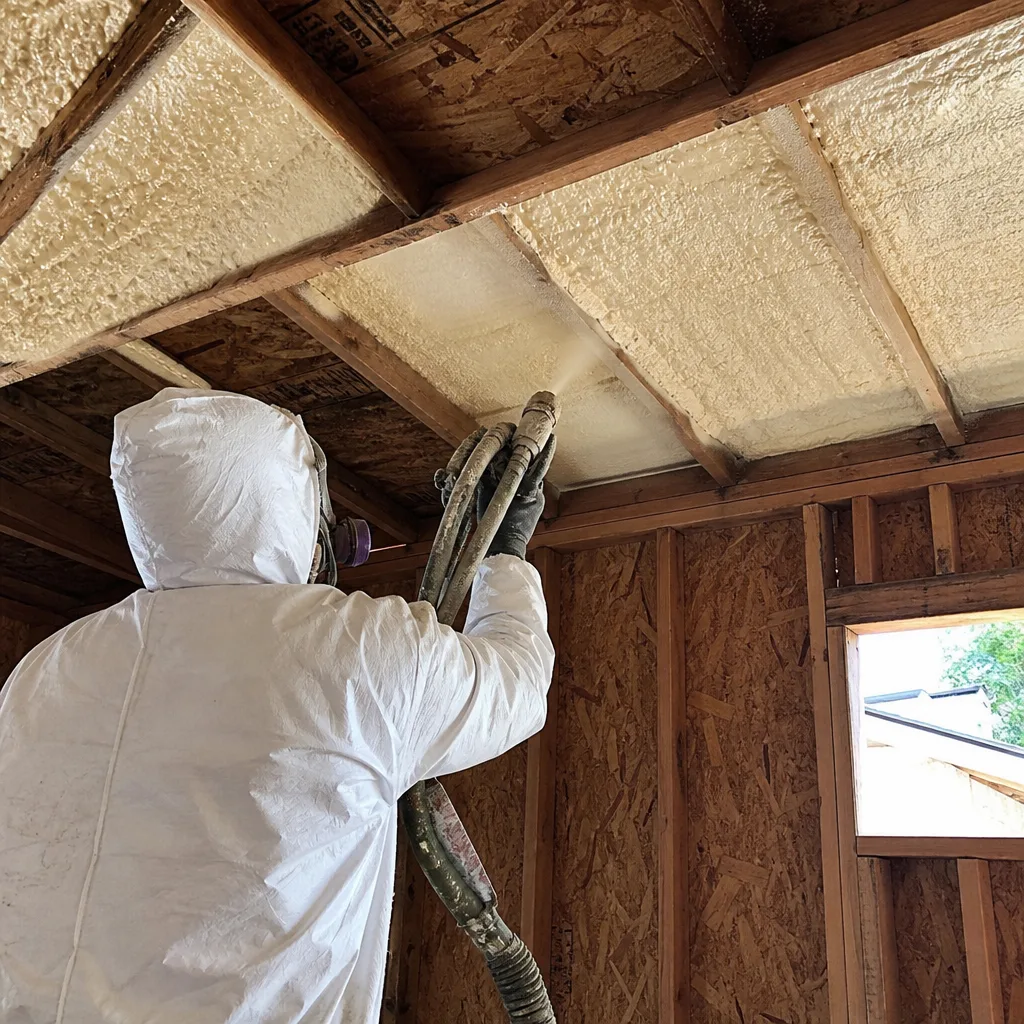
Closed-cell spray foam is the only common insulation material that functions as both insulation and air barrier in a single product. See our Spray Foam Insulation Maintenance Checklist for San Bernardino Homeowners for ongoing care. When installed at the right depth, closed-cell foam (like Demilec or Icynene closed-cell products) can serve as the building’s air barrier directly, simplifying the CF3R by consolidating two requirements into one material. Open-cell foam is not a vapor or air barrier at thin depths and must be paired with additional air sealing details.
If you’re considering Spray Foam Insulation in San Bernardino, the code requirement is not simply “spray foam in the cavity.” The CF1R will specify the foam type, depth, and whether it’s designated as the air barrier material. The CF3R verifies that designation. Not all spray foam installations satisfy the air barrier mandate by default.
Climate Zone 10 R-Value Requirements in San Bernardino
San Bernardino falls in California Climate Zone 10. This zone covers the Inland Empire’s warmer inland areas, where summer cooling loads drive more of the annual energy use than winter heating. The zone designation matters because R-value minimums are zone-specific, and what makes sense in a coastal Climate Zone 6 home isn’t automatically right for a San Bernardino house. Our Seasonal Insulation Care for San Bernardino: Year-Round Homeowner’s Guide explains how to maintain performance through temperature swings.
Current 2022 Energy Code prescriptive minimums for Climate Zone 10, for wood-framed residential construction:
- Ceiling insulation: R-38 minimum for vented attics. R-30 is acceptable in limited cases where existing structure physically cannot accommodate R-38 depth, but this requires documentation and is not the default.
- Wood-framed walls: R-13 cavity insulation combined with R-4 continuous exterior insulation, or R-15 cavity without continuous exterior insulation, or the approved performance-equivalent alternative. Most retrofit work in San Bernardino uses existing 2×4 framing, so R-15 high-density batts or closed-cell foam fill are common compliance paths.
- Raised floors: R-19 minimum for raised wood floors over unconditioned crawl spaces. Homes in the foothill areas of San Bernardino near the 210 corridor frequently have raised foundations, and this is a commonly overlooked minimum.
- Duct insulation: R-8 minimum for ducts in unconditioned spaces (attics, crawl spaces). R-6 for ducts in conditioned spaces. If your HVAC ductwork runs through a vented San Bernardino attic at R-4.2, it’s below code and losing capacity to heat gain.
The gap between code minimums and what installers commonly propose is where homeowners get burned. We regularly see proposals in San Bernardino that quote R-30 ceilings because that’s what the installer’s default software template generates. R-30 doesn’t meet Climate Zone 10 prescriptive requirements. A CF1R that shows R-30 for a new ceiling would fail plan check. For existing attics being brought up to code during a re-roof, the city may hold you to R-38 even if the original home had R-19.
Where we use Owens Corning and Johns Manville fiberglass products, the R-value math is straightforward: read the product spec, match it to the zone table, and document it on the CF3R. Where homeowners prefer stone wool from Rockwool for fire resistance in hillside areas, the same zone minimums apply. The material changes. The R-value requirement doesn’t.
What Inspectors Actually Look For During an Insulation Inspection
If your insulation work is under permit in San Bernardino, the city inspector will verify four things on site. Understanding these ahead of time prevents failed inspections, re-visit fees, and scheduling delays.
- R-value verification: For blown-in, the inspector will check the depth against the settled density chart for the material used. For batts, they’ll read the R-value printed on the batt facing. For spray foam, they’ll check installed depth against the CF1R specification. If the installed value is below the CF1R requirement, the inspection fails on the spot.
- Coverage and gaps: The inspector looks for voids, compressed batts, gaps around wiring and plumbing, and missed cavities in walls. Attic inspection is visual from the hatch if there’s no permanent access; the inspector may ask for photos of inaccessible areas. Knee wall areas and skylight shafts are frequent failure points in San Bernardino homes.
- Air barrier details: Under the 2022 code, the inspector verifies that the air barrier work listed on the CF3R was actually done. Recessed can lights must have rated covers before insulation covers them. Top plates must be sealed or foamed. The attic hatch must have weatherstripping and an insulated cover. Electrical and plumbing penetrations must be sealed. These details are on the CF3R and are inspectable.
- Duct and plumbing clearances: Insulation can’t bury vent pipes from combustion appliances without the proper clearances, and it can’t cover supply ducts in a way that compresses the duct wrap. The inspector checks clearance around furnace flues, gas vents, and chimney penetrations. This is a safety inspection point as much as a code check.
For Blown In Insulation in San Bernardino, the inspector’s depth check is the most common reason for a pass or fail. We document depths at each quadrant of the attic and note them on the CF3R before the inspector arrives. The inspector checks. It matches. The inspection clears. That’s the way the system is supposed to work.
What Happens When Unpermitted Insulation Is Discovered
Unpermitted insulation work surfaces most often during a home sale, a refinance appraisal, or an insurance claim inspection. The discovery rarely happens because the city came looking. It happens because a buyer’s inspector, an appraiser’s notes, or an insurance adjuster flags work that has no permit record and no CF3R on file.
The remediation reality in San Bernardino falls into three tiers, from cheapest to most expensive:
- Tier 1: Documentation gap, work otherwise fine. The insulation was installed correctly, the R-value meets code, but no permit was pulled and no CF3R exists. The fix is a title-24-compliance inspection, also called a “compliance with existing conditions” review. A HERS rater or city inspector evaluates the existing insulation and generates documentation. Cost: typically $400 to $1,200 depending on access and the scope of testing. This is the best-case scenario and the most common outcome.
- Tier 2: Work below code, requires retrofit. The insulation was under-installed or improperly installed. The attic has R-19 when Zone 10 requires R-38. The air sealing was never done. The fix is a retrofit to meet current code: remove or supplement insulation, add air sealing, re-inspect, document. Cost: $3,000 to $12,000 for a typical San Bernardino attic, depending on square footage and what’s underneath the existing material.
- Tier 3: Work below code and unpermitted within a room addition or conversion. The insulation was part of a garage conversion, bonus room, or ADU done without permits. The fix is a full as-built permit application, which may require plan review, structural review, and bringing everything in the conversion up to current code, not just the insulation. Cost: $10,000 to $40,000 or more depending on the scope. This is the nightmare scenario, and it’s more common in San Bernardino’s older housing stock than most agents want to admit.
The protection is simpler than the fix: demand CF1R and CF3R copies at the completion of any insulation work done under permit, and ask your real estate agent to include building permit history in the due diligence review whether you’re buying or selling. An extra $12 at the city records office can prevent a five-figure remediation later.
Common Mistakes to Avoid
- Assuming insulation never needs a permit in California. Like-for-like replacement is exempt. New insulation, envelope changes, or work done alongside a permitted project is not. If you’re in San Bernardino and unsure, call the building counter before you start, not after.
- Accepting verbal quotes without written R-value specifications. A quote that says “insulate attic” without stating the material, the R-value target, and whether air sealing is included gives you no baseline to verify the work. You’ll get something. You won’t know if it’s what Zone 10 requires.
- Treating air sealing as optional upsell. Under the 2022 Energy Code, air sealing is part of the compliance package, not an add-on. An installer who quotes insulation without addressing the air barrier is quoting a code-incomplete job.
- Not requesting CF1R and CF3R copies before paying the final invoice. These documents are your only proof of compliance. Get them in hand. File them. A year from now, when you sell or claim, they’re the difference between “work was done” and “work was proven.”
- Letting a roofer or general contractor handle insulation as a side item. Roof replacement in San Bernardino frequently requires bringing attic insulation to current code. A roofer who subs out insulation to the lowest bidder without running Title 24 compliance risks leaving you with a code gap and no documentation.
- Ignoring duct insulation in the attic. R-8 duct wrap is a Zone 10 requirement. If your ducts are running bare or under-wrapped in a vented San Bernardino attic, your cooling system is losing capacity to the hottest air in the house. Most homeowners don’t know to check.
- Waiting until escrow to address unpermitted work. Discovery during a sale puts you on a timeline with limited negotiation leverage. Fix it on your schedule, not the buyer’s.
When to Call a Professional
You need a licensed, professional insulation contractor when the scope of your project involves any of the following: opening walls or adding insulation where none existed, converting unconditioned space to living area, re-roofing an existing home in San Bernardino where the attic insulation will be touched or requires compliance verification, any work where a CF1R or CF3R is required, or any situation where you’re not certain whether your existing insulation meets current code. Insulation work that touches the building envelope, air barrier, or a permit path is not a weekend project. A contractor who does insulation and nothing else will know the Zone 10 minimums, the 2022 air barrier language, and the San Bernardino inspection expectations without looking them up. Comfort Zone Insulation Co offers free estimates in San Bernardino. Call (855) 341-7856 to talk through your project before you pull a permit or sign a contract.
Frequently Asked Questions
Adding or replacing insulation in an existing attic is generally treated as maintenance and does not require a standalone permit in California, as long as the work is like-for-like and doesn’t involve structural changes or conditioned space conversion. However, San Bernardino enforces the 2022 air barrier mandate, so any attic air sealing done with the insulation project falls under code verification. Call (855) 341-7856 if you want help scoping your project against current San Bernardino requirements.
Climate Zone 10 (which includes San Bernardino) requires R-38 minimum for ceilings in vented attics. R-30 is acceptable only in documented cases where physical space constraints prevent R-38 depth. For an exact answer based on your attic geometry and current condition, call us at (855) 341-7856 for a free assessment.
The CF1R is a compliance certificate that specifies required insulation values; the CF3R is the installation certificate that verifies what was actually installed. They’re required for any insulation work done under permit. For exempt maintenance work, you don’t need them, but you do need to ensure the work meets current code so you don’t create a compliance gap you’ll pay for later.
If the work was done correctly but without permits or documentation, a compliance inspection typically costs $400 to $1,200. If the work is below code and requires retrofit, the cost in San Bernardino typically ranges from $3,000 to $12,000 for a standard attic. For unpermitted conversions that include insulation, the fix can run far higher. Call (855) 341-7856 for an honest assessment based on what you’re working with.
Yes. Under the 2022 Energy Code, batt insulation in conditioned spaces must be installed in contact with a designated air barrier on all six sides, and penetrations must be sealed. Batt insulation alone is not an air barrier. If you have fiberglass batts in a San Bernardino attic or exterior wall, air sealing must be documented as part of the installation.
You can install insulation yourself as a homeowner in many cases, and like-for-like replacement doesn’t require a permit. But the work still must meet current code if the installation touches conditioned space, and you’re responsible for understanding what Zone 10 requires. Mistakes in attic insulation are expensive to undo once the material is down. We’ve corrected more DIY attic work in San Bernardino than we’d like to count. If you’d rather have it right the first time, call (855) 341-7856.
The Bottom Line
California’s insulation code exists to make homes perform, not to create paperwork for its own sake. The 2022 standards raised the bar for every insulation type, added the air barrier mandate, and shifted enforcement toward documented, verified installation. If you’re a homeowner in San Bernardino, the path is straightforward: understand whether your scope triggers a permit, insist on CF1R and CF3R documentation, verify the R-values against Climate Zone 10 minimums, and don’t let anyone tell you air sealing is optional. Insulation done right becomes invisible in the best way: the house holds temperature, the bills drop, and the paperwork is there if you ever need it. Done wrong, it becomes a problem you’ll rediscover at the worst possible time.
Need help making sure your project meets California code? Call Comfort Zone Insulation Co at (855) 341-7856 for a free estimate. We install insulation and nothing else. We carry eight brands so the right material is always an option, and we do the paperwork the code requires.
Written by the team at Comfort Zone Insulation Co, serving San Bernardino since 2012.