
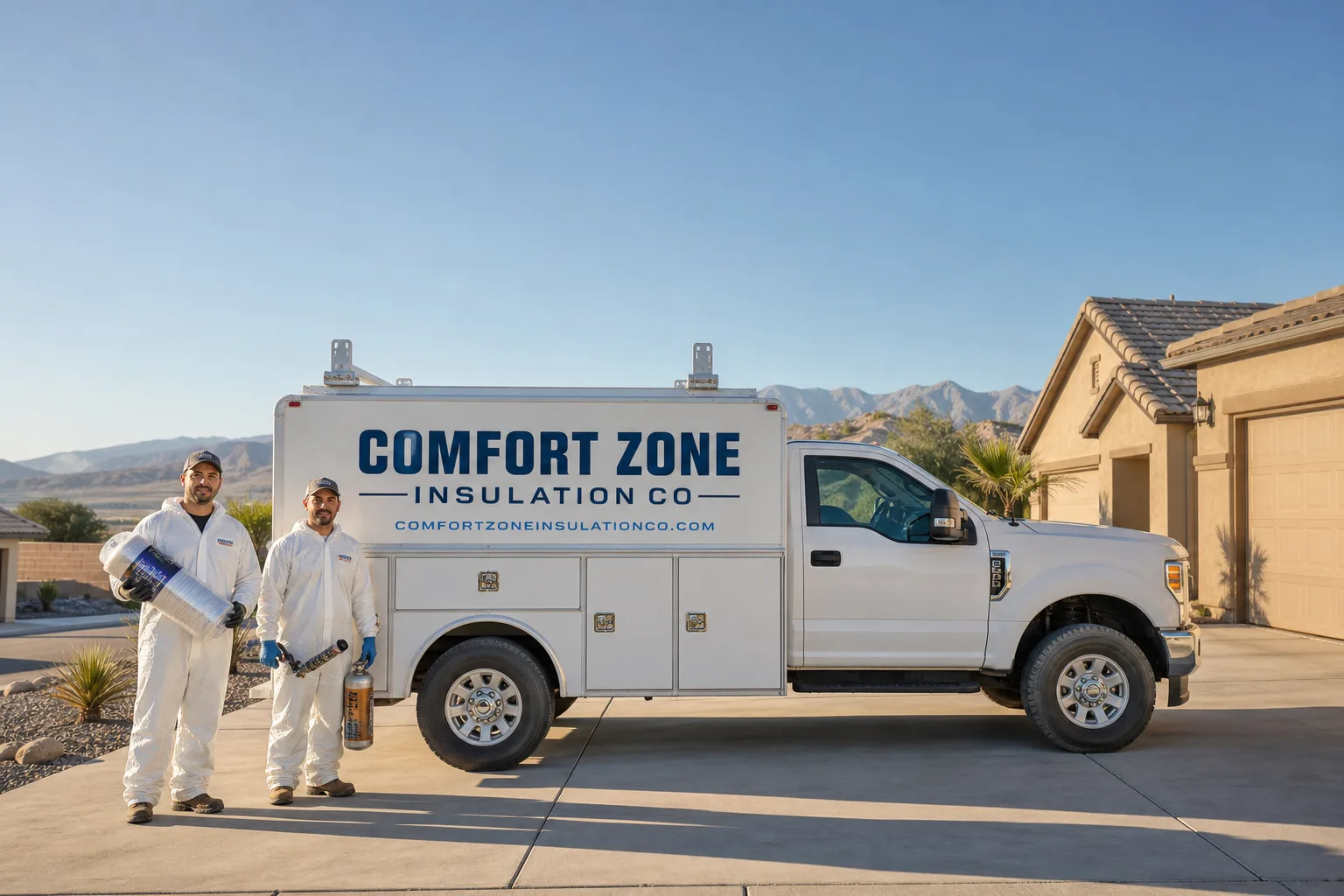
Fast, Reliable Spray Foam Insulation Across Morongo Valley
Spray foam insulation in Morongo Valley typically runs $2,800 to $6,400 for a full attic air-seal and roof-deck application on a 1,200 to 1,800 square foot home, and most projects finish in one to two days. We work throughout the 92256 zip code, from the older homestead parcels along Hess Boulevard to the cabins tucked into the hills above Highway 62. If your Morongo Valley home struggles to hold temperature after sunset or your attic insulation has been shoved to one gable by spring winds, call Noel Carrasco and the Comfort Zone Insulation Co team at (855) 341-7856 for a free site evaluation.
Why Comfort Zone Insulation Co Is Morongo Valley’s Preferred Spray Foam Insulation Company
We’re insulation specialists and nothing else. That distinction matters in Morongo Valley, where the housing stock runs from 1950s site-built homesteads to manufactured homes and cabins that were never designed for the temperature swings this elevation delivers. General contractors who dabble in insulation tend to treat every home the same. We don’t, because we’ve walked enough Morongo Valley attics to know that a 1960s cabin off Highway 62 and a 1980s rancher near Desert Edge fail for entirely different reasons.
Noel Carrasco leads a crew that works this corridor regularly, so we’re not learning your microclimate on your dime. We know the wind patterns that funnel through the Morongo Basin in spring, the way the 30 to 40 degree Fahrenheit day-to-night swing stresses an unsealed attic, and the reality that most homes up here have had decades of piecemeal owner upgrades. That local familiarity means we diagnose before we quote. We don’t spray foam over a problem we haven’t identified.
Our Morongo Valley customers consistently point to two things in their feedback: the honesty of our material recommendations and the speed of our response. Because we carry eight manufacturer lines, including Spray Foam Insulation systems from Icynene and Demilec, we’re not limited to whatever single product happens to be in the warehouse this week. We recommend what fits your home’s reality, not what fits our inventory.
Open Cell Spray Foam in Morongo Valley
Open Cell Spray Foam is the material we recommend most often for Morongo Valley attic roof decks, and the reasoning is specific to this town’s climate. At 2,600 to 3,000 feet with a 30 to 40 degree daily swing, your attic expands and contracts daily. Open cell foam, applied to the underside of the roof deck, moves with the framing instead of fighting it. It also creates an air seal that stops the wind washing that loose-fill and batt insulation cannot survive. A typical open cell application on a 1,200 square foot Morongo Valley attic runs $2,800 to $4,900.
Wind-Resistant Roof Deck Applications
The spring windstorms that come over the Little San Bernardino range push through open attic vents with enough force to relocate loose insulation entirely. We routinely find fiberglass or cellulose packed against the west or north gable end, leaving the opposite side of the attic bare. Open cell foam applied to the roof deck eliminates that failure mode because it adheres in place. It doesn’t blow anywhere.
When Open Cell Fits a Legacy Homestead Attic
For a 1960s or 1970s homestead with an unconditioned attic and visible top plates, open cell is often the highest-performing retrofit available. It air-seals the wall top plates, fills odd framing cavities that batts never fit correctly, and handles the condensation concerns of cold winter nights in the 20s. We still verify the existing cavity condition first. Foam is an air barrier, not a Band-Aid for moisture trapped under old, dirty insulation.
Spray Foam Insulation Contractors in Morongo Valley
Spray Foam Insulation Contractors who understand this specific corridor are rare, and that’s not marketing talk: the local failure modes here are genuinely different from anything a downslope contractor sees in the San Bernardino Valley. Most flatland crews treat insulation as an R-value exercise. In Morongo Valley, it’s a wind-and-air-sealing exercise first. We scope every job by checking attic cavity displacement and top-plate air leaks before we talk about foam depth. A full attic air-seal plus spray foam retrofit in Morongo Valley typically lands between $3,900 and $6,400.
Air Sealing Before Foam, Every Time
Spray foam applied over unsealed vent chutes and top plates still loses the thermal fight, because the daily temperature swing drives air straight through the assembly. We seal the bypasses first, then apply foam at a consistent depth. This sequencing is the difference between a home that holds temperature and one that just has newer insulation performing like the old stuff.
Evaluating Before You Retrofit
Morongo Valley’s 1950s through 1980s housing stock frequently shows mixed, variable-depth insulation from decades of owner upgrades. Someone added batts in one bay, blew cellulose in another, and never touched a third. A straight spray-foam pass over that chaos seals the air leaks into the attic, but buries the underlying problem. We evaluate the cavities first, document what’s actually there, and then recommend the right material for each zone. Noel Carrasco personally reviews every Morongo Valley attic assessment before we quote.
Trusted Brands We Service in Morongo Valley
For Morongo Valley homeowners, brand access translates to fit. We install open- and closed-cell systems from Icynene and Demilec, two of the most recognized spray foam product lines in North America, and we also carry mineral wool from Rockwool and blown-in products from Owens Corning for hybrid applications. That range matters up here, where a cabin with exposed framing may need a different approach than a manufactured home with a tight attic chase. We stock the materials our Morongo Valley jobs regularly require, which keeps turnaround tight when a spring wind event exposes a problem and you need it addressed before the summer heat arrives. Call (855) 341-7856 and we’ll tell you honestly which material fits your specific situation.
Common Spray Foam Insulation Problems We See in Morongo Valley Homes
- Wind-displaced attic insulation. Spring winds crossing the Little San Bernardino range push loose-fill or batts through open attic vents, packing them against the west or north gable. We routinely find the opposite side of the attic with bare drywall showing through, which means half your ceiling has effectively zero thermal protection.
- Piecemeal owner-upgraded cavities. Decades of incremental DIY work in 1950s to 1980s homestead homes leaves mixed, variable-depth material that hides air leaks a straight foam pass would seal over without fixing. The insulation isn’t the problem; the missing evaluation is.
- Foam applied without wind-washing control. Unsealed vent chutes and top plates let the 30 to 40 degree Fahrenheit diurnal swing drive heat loss and gain straight through the assembly, even with new foam in place. The foam is only as good as the air seal behind it.
- Moisture trapped under old insulation. High-desert cabins that see winter nights in the 20s and 30s can trap condensation under legacy insulation. Spraying foam over damp, dirty material without evaluating what’s underneath creates a moisture problem you won’t find until the smell or the mold shows up.
Pricing for Spray Foam Insulation in Morongo Valley, CA
Here’s what we actually see on the ground in the 92256 market. Open-cell spray foam on an attic roof deck runs $2.20 to $3.10 per square foot of surface area. A full attic air-seal plus roof-deck application on a 1,200 to 1,800 square foot Morongo Valley home typically lands between $3,900 and $6,400 total. Rim joist spray foam, common in older homesteads with unconditioned crawl spaces, runs $900 to $1,800 depending on joist count and access. Closed-cell applications, which we recommend for exposed underside work or areas needing a vapor barrier, run $3.40 to $4.80 per square foot. The biggest cost driver in Morongo Valley isn’t square footage; it’s cavity condition. Homes with mixed legacy insulation or displaced material require evaluation and prep work before foam goes in. We provide a written, line-item quote before any work starts. Estimates are free. Call (855) 341-7856 and we’ll schedule a site visit within a few days.
We Also Serve Cities Near Morongo Valley
Our crews work the entire Morongo Basin corridor, so if you’re in Desert Edge, Garnet, Desert Hot Springs, or Yucca Valley, the same Morongo Valley expertise applies to your home too. We schedule routes through this area weekly, which keeps response times short and travel costs out of your quote. Call us and tell us where you are. We’ll tell you when we can be there.
Serving Morongo Valley, CA — Our Local Coverage Area
We’re based in the Morongo Valley area and know this community well. Use the map below to see our service coverage — if you’re nearby, we can almost certainly help.
FAQs About Spray Foam Insulation in Morongo Valley
Spring winds crossing the Little San Bernardino range enter through open attic vents with enough force to push loose-fill and batt insulation across the attic floor, packing it against the west or north gable end. The fix is to stop the air movement at the source with air sealing and an adhered insulation like spray foam that doesn’t relocate. A wind-resistant attic assembly is a spray foam retrofit, not a replacement of the loose-fill that just blew out. Call (855) 341-7856 for a free attic inspection to see if wind has already compromised your existing insulation.
Open cell is often the best fit for a 1960s cabin in Morongo Valley because it adheres to the roof deck, moves with old framing through the daily temperature cycles, and air-seals the top plates that never got sealed when the cabin was built. It’s not automatically the right choice for every cabin, but it’s the material we recommend most frequently for unconditioned attics in this climate. Your cabin’s specific condition, roof pitch, and existing insulation will determine the final recommendation. Call us and we’ll walk the attic with you.
A 30 to 40 degree Fahrenheit day-to-night swing means your attic experiences daily cycles of expansion, contraction, and air movement that flatland homes never see. Spray foam work here must include thorough air sealing before the foam goes on, because any gap in the air barrier gets exploited twice a day by thermal pressure differences. Wind washing through unsealed vents compounds the problem. The temperature swing doesn’t change the foam itself; it changes the sequencing and scope of the job.
No, and anyone who tells you otherwise is selling square footage, not performance. Spray foam applied over old, dirty, or damp legacy insulation traps whatever moisture and air-movement problems already exist in the cavity. In Morongo Valley’s 1950s to 1980s housing stock, where most attics show mixed, variable-depth material from decades of piecemeal upgrades, evaluation comes first. We document what’s in the cavity, remove or correct what needs addressing, and then apply foam. That sequencing is why our results hold up. Call (855) 341-7856 to get an honest assessment of what’s actually in your attic.
Most don’t, because the failure modes here are specific to elevation and wind patterns a downslope crew never encounters. A contractor who works the San Bernardino Valley heat treats insulation as an R-value number. Up here, wind displacement through attic vents, 30 to 40 degree daily swings, and legacy homestead cavities are the real problems. That’s the difference between a generic spray foam pass and a Morongo Valley-specific retrofit. Our crew works this corridor regularly and Noel Carrasco personally reviews every assessment. Call (855) 341-7856 to talk to a specialist who understands your home’s conditions.
Contact Comfort Zone Insulation Co in Morongo Valley
If your Morongo Valley home isn’t holding temperature, if your attic insulation has blown to one side, or if you suspect decades of piecemeal upgrades left your cavities with more gaps than coverage, call us. We’ll send a crew to evaluate the attic, document what’s there, and recommend the right material for your specific situation. Not whatever we happened to order this week. Call (855) 341-7856 for a free estimate, or reach out through our site and we’ll get Noel Carrasco on the phone with you.
Written by Noel Carrasco, Owner at Comfort Zone Insulation Co, serving Morongo Valley and the Morongo Basin since day one.