
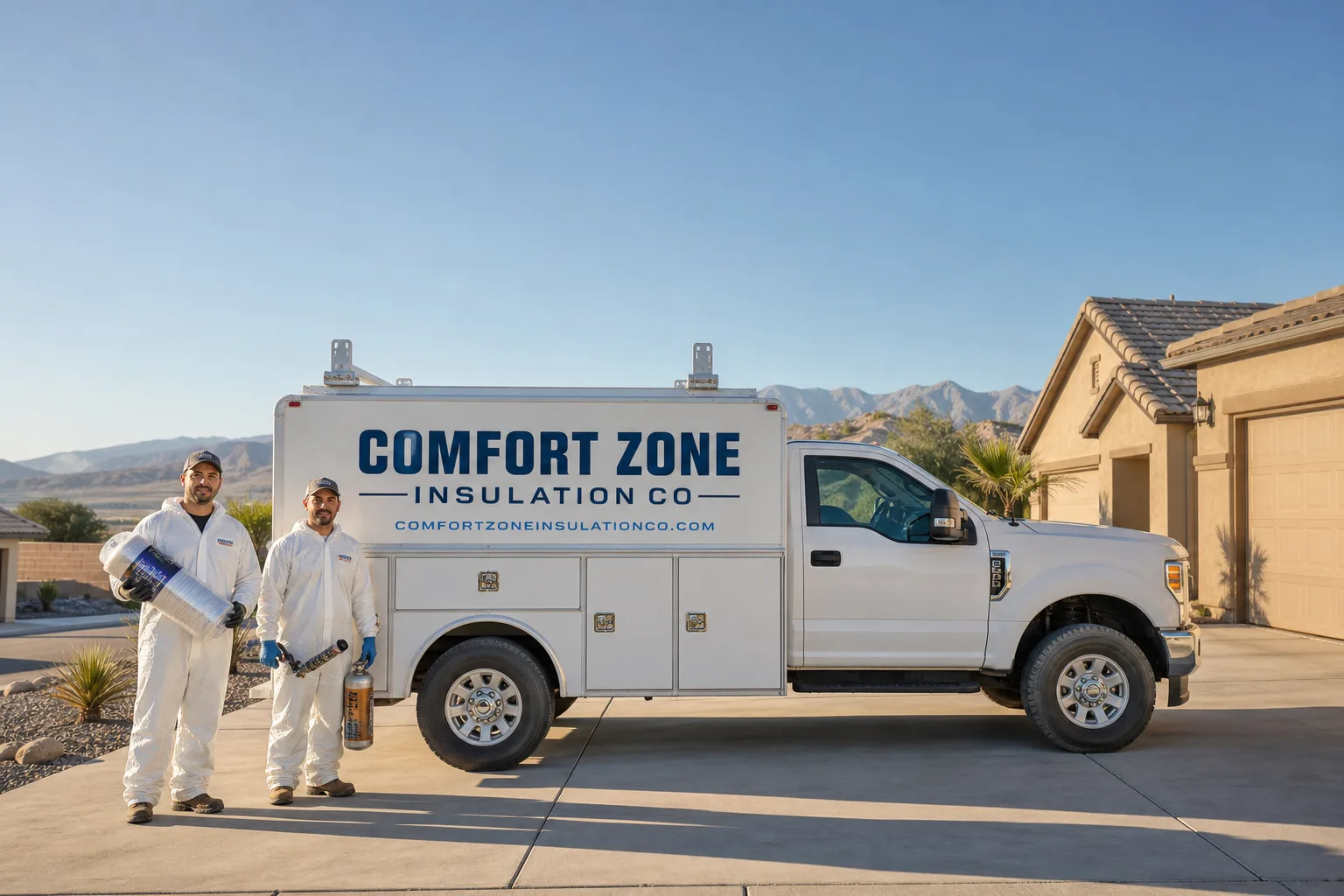
Fast, Reliable Spray Foam Insulation Across Desert Edge
Spray foam insulation in Desert Edge is the most direct way to stop the wind-driven sand and 110°F attic heat that make homes on the western rim of the Coachella Valley so hard to keep comfortable. We work in the 92240 zip code every week, and we know exactly what happens to a house out here when insulation gets fouled by blowing grit. A properly sealed and foamed attic in Desert Edge can cut cooling costs substantially during the summer months, but only when the old material is pulled and the substrate is clean enough for the foam to bond. Call us at (855) 341-7856 for a free estimate from our Spray Foam Insulation team.
Why Comfort Zone Insulation Co Is Desert Edge’s Preferred Spray Foam Insulation Company
Desert Edge presents a set of insulation problems that you won’t find in most of the Coachella Valley. Wind coming off the San Gorgonio Pass drives fine sand into roof vents and gable gaps, where it mixes with blown-in attic material and compacts it into a dense, gray mat that no longer works. We see this constantly on the Desert Edge side of the valley, and we build our approach around it. Our crews pull the fouled material, clean the substrate, and apply spray foam as a bonded air barrier, not just a thermal layer. That’s the only way to keep the wind path from reloading the envelope with dust month after month.
Noel Carrasco has built Comfort Zone Insulation Co around one idea: we install insulation and nothing else. When a homeowner in Desert Edge calls us, they get an insulation-only specialist who diagnoses the real problem, not a general contractor who treats the attic as an afterthought. We carry products from eight leading brands including Johns Manville, Knauf, and CertainTeed, which means the material we recommend for your Desert Edge home is the one that fits your situation, not whatever happened to be in stock.
Garage Spray Foam Insulation in Desert Edge
Garage Spray Foam Insulation in Desert Edge typically runs $1,200 – $2,800 for a standard two-car garage, and the job changes depending on whether the garage shares a wall or ceiling with the living space. Many homes in the 92240 area have attached garages built in the mid-century or 1970s era, with zero insulation above the ceiling. In summer, the garage becomes a heat sink that radiates into the house for hours after sunset. We address this by air-sealing the common wall and applying closed-cell foam to the ceiling deck or rafter cavity, depending on the home’s construction.
Attached garages on desert west-side homes
When a garage shares a wall with a bedroom or kitchen, the temperature differential in Desert Edge can exceed 40 degrees on a July afternoon. We treat the common wall as an air barrier first, then insulate it. Closed-cell foam at 2 inches gives you both R-value and the air-seal that fiberglass batts cannot provide.
Detached and workshop garages
For a detached garage used as a shop or storage space, we typically recommend 1 – 1.5 inches of closed-cell foam on the walls and roofline. This blocks dust and radiant heat at a lower cost than a full thermal envelope. The garage stays substantially cooler, and the sand that normally sifts through the wall framing after a windy day stays out.
Closed Cell Spray Foam Insulation in Desert Edge
Closed Cell Spray Foam Insulation in Desert Edge is the standard we recommend for most attic and rim joist work, and it typically runs $1.50 – $3.00 per board foot installed, depending on depth and access. In the 92240 climate, closed-cell foam does two jobs at once: it insulates and it air-seals. The dense, rigid cell structure resists the wind pressure that pushes sand and dust through tiny openings in the envelope. It also adds structural rigidity to older framing, which matters with the thin rafters and 2×4 trusses common in mid-century Desert Edge construction.
Bonded air sealing over cleaned substrate
The local failure mode we fix most often is foam that was sprayed over old, sand-fouled batts and then peeled away within a season. Closed-cell foam bonds mechanically and chemically to the surface it is applied to. If that surface is loaded with wind-blown grit, the bond fails. We pull the old material first, every time.
UV-stable coverage at gable ends
Foam left exposed at gable ends or open attic penetrations breaks down fast under the intense solar load of a Desert Edge summer. We always ensure closed-cell foam in exposed areas gets a thermal or ignition barrier coating, which extends the service life dramatically and prevents the chalky surface degradation that ruins an otherwise good install.
Trusted Brands We Service in Desert Edge
We install and service spray foam systems from brands our Desert Edge customers ask for by name, including Johns Manville, Knauf, and CertainTeed. Being material-agnostic matters here. A 1970s tract home with shallow attic cavities will have a different foam requirement than a manufactured home or a newer build with a sealed attic design. We stock common parts locally so turnaround on Desert Edge jobs is fast. Call (855) 341-7856 and we can tell you what product fits your home’s construction before we ever set foot in the attic.
Common Spray Foam Insulation Problems We See in Desert Edge Homes
- Sand-fouled substrate causing bond failure. Wind-driven sand packs into roof vents and gable gaps, leaving a layer of grit on everything in the attic. Closed-cell foam sprayed over that layer will delaminate. The old material has to come out before new foam goes in.
- Compacted and flattened attic insulation. Original fiberglass batts from the 1970s and 1980s era often look gray and matted from years of wind-driven dust loading. R-value drops sharply. Pulling and replacing this material is one of the most common jobs we do in the 92240 area.
- UV and heat degradation at exposed edges. Foam left unprotected at gable ends or open attic penetrations breaks down under 105 – 115°F summer heat and intense UV. We see chalky, crumbled foam that was never coated or covered properly.
- Thin or off-ratio foam passes in shallow cavities. Mid-century and early desert tract homes have thin, uneven ceiling cavities that challenge even experienced applicators. A rushed pass leaves air gaps. Dust finds those gaps. We slow down and inspect every pass with an eye toward the wind-driven dust that’s coming back next season.
Pricing for Spray Foam Insulation in Desert Edge, CA
A full attic spray foam job in Desert Edge typically runs $3,500 – $7,500 depending on square footage, access, and whether the old insulation needs pulling first. A rim joist job in a 1970s-era home usually falls between $900 and $2,200. Garage ceiling spray foam runs $1,200 – $2,800 for a standard two-car garage. What moves the number is almost always the condition of the existing attic material. Sand-fouled batts take longer to pull and dispose of. Clean removal means the new foam bonds correctly the first time. We never quote a Desert Edge job without seeing the attic. Estimates are free, and we’ll walk you through what we find. Call (855) 341-7856 to schedule a visit.
We Also Serve Cities Near Desert Edge
Our crews work throughout the western Coachella Valley. We regularly serve Desert Edge plus Garnet, Desert Hot Springs, Morongo Valley, and Palm Springs. Each area has its own wind exposure and building stock, and we adjust our approach accordingly. If you’re in a neighboring community and wondering whether your attic has the same sand-fouling problem we see in the 92240 area, call us and we’ll take a look.
Serving Desert Edge, CA — Our Local Coverage Area
We’re based in the Desert Edge area and know this community well. Use the map below to see our service coverage — if you’re nearby, we can almost certainly help.
FAQs About Spray Foam Insulation in Desert Edge
That gray, matted appearance comes from wind-driven sand and dust that has blown into your attic through roof vents and gable gaps over many years. The dust settles into the fiberglass and compacts it, destroying the loft that gives the insulation its R-value. We see this constantly on the western edge of the Coachella Valley, and the fix is to pull the fouled material, air-seal the penetrations, and apply spray foam as a bonded air barrier. Call (855) 341-7856 and we’ll inspect yours.
No, and this is the most important thing to understand about spray foam in Desert Edge. Foam needs a clean substrate to bond. Old batts loaded with wind-blown grit prevent that bond, so the foam peels away within a season. The old material has to be pulled first. On one 1970s tract home near the western edge of Desert Edge, our crew found original fiberglass batts matted flat and gray with sand that had worked in through the roof vents and a gable gap. We pulled the fouled material, air-sealed the top plates and penetrations, then applied closed-cell spray foam to the attic roofline so the same wind path couldn’t keep loading the envelope with dust. The homeowner’s 110°F-afternoon attic went from an oven to a sealed, dust-blocked assembly.
Yes, that’s often the primary reason we recommend closed-cell spray foam on the Desert Edge side of the valley. The stuff that leaks through your ceiling on a windy day isn’t just air, it’s air carrying fine sand from the wash and the open desert. Closed-cell foam is a dense air barrier, and when applied correctly over a cleaned substrate, it stops that wind path at the roofline. R-value is important, but for many of our 92240 customers, the dust-stopping benefit is what they notice first. Call (855) 341-7856 for an attic evaluation and a free estimate.
For most Desert Edge garages, closed-cell is the better fit. It carries a higher R-value per inch, which matters in the shallow ceiling cavities of mid-century housing. It also acts as an air and dust barrier, and it stiffens the thin framing common in older desert tract construction. Open-cell is less expensive, but it doesn’t block wind-driven dust the way closed-cell does. We carry both, and we’ll recommend the one that matches your garage’s construction and how you use the space. Call (855) 341-7856 to talk through it.
A Desert Edge attic can hit 130 – 150°F on a July afternoon, which is why foam installed here has to withstand heat and UV that sheltered inland areas never see. Foam left exposed at gable ends degrades quickly under that solar load. The heat also affects application timing. We schedule early-morning starts during the summer because spraying in a 140°F attic creates curing problems and compromises the foam’s cell structure. It matters a lot, and it’s one of the reasons a local insulation-only crew beats a general contractor who shows up mid-afternoon. Call (855) 341-7856 to schedule a free estimate.
Written by Noel Carrasco, Owner at Comfort Zone Insulation Co, serving Desert Edge and the surrounding Coachella Valley.