
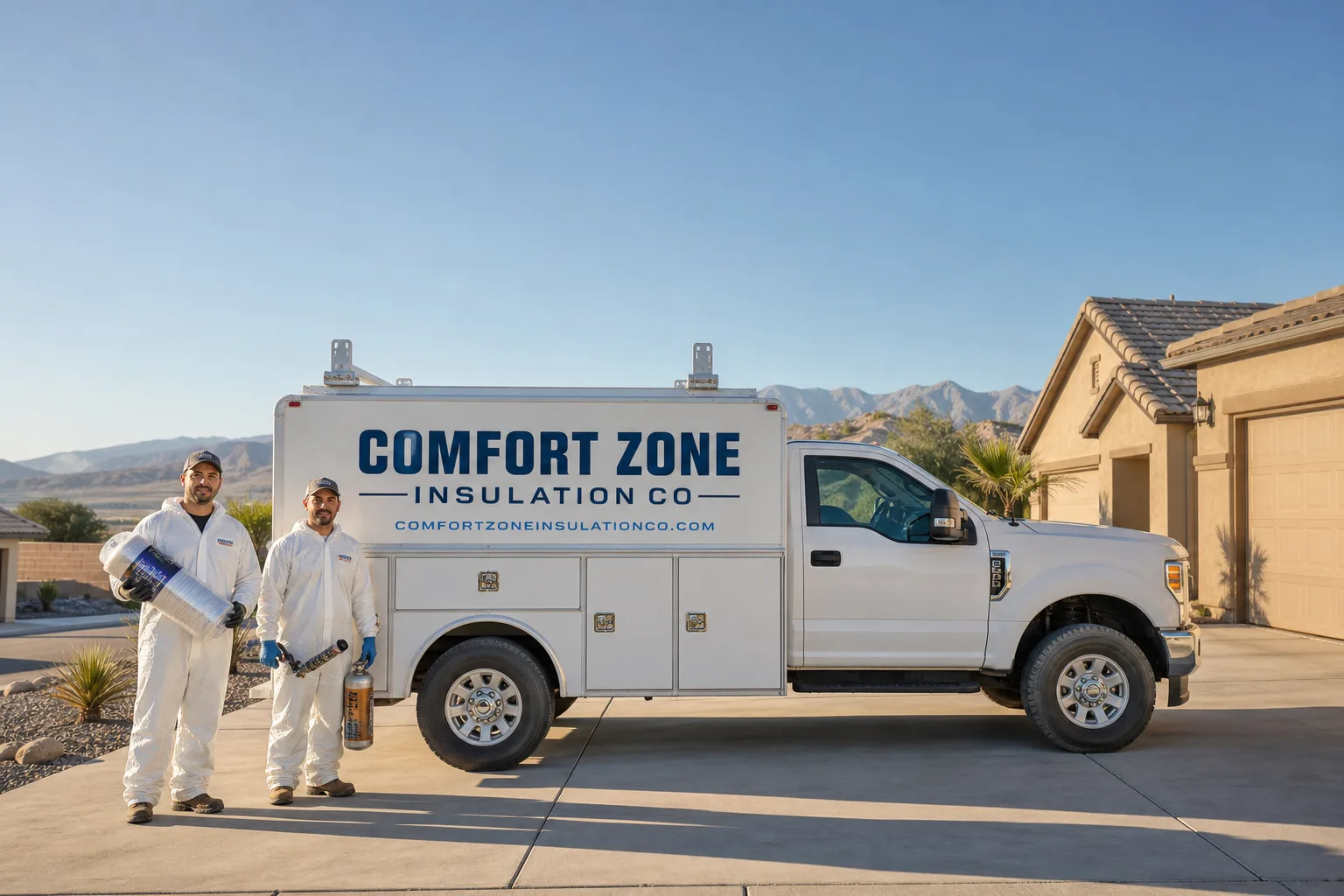
Fast, Reliable Spray Foam Insulation Across Grand Terrace
Spray foam insulation in Grand Terrace usually runs between $2,800 and $6,500 for a full attic retrofit, depending on cavity depth and whether you’re sealing rim joists, walls, or a crawl space at the same time. Most jobs we schedule in the 92313 ZIP take one to two days once the foam is applied, and we typically reach Grand Terrace homes within 24 to 48 hours of your call. If you’re tired of rooms that spike past 90°F by mid-afternoon or a thermostat that never seems to win, call (855) 341-7856 and we’ll do a proper assessment, not a sales pitch.
Why Comfort Zone Insulation Co Is Grand Terrace’s Preferred Spray Foam Insulation Company
We install insulation and nothing else. That focus matters in Grand Terrace because the housing stock here wasn’t built for modern R-value expectations. Foam in the wrong place, or applied without air sealing first, wastes your budget and sometimes makes things worse. Homeowners in Grand Terrace call us because we diagnose before we quote, and because we carry eight brands, including Johns Manville and Rockwool, so the recommendation is based on your attic and wall conditions, not what’s sitting in a warehouse.
Noel Carrasco runs our crew and has walked attics across Grand Terrace, from the flat tract streets near Barton Road to the hillside lanes climbing Blue Mountain. We know what a 1960s vented attic looks like, what a 1980s hillside cavity demands, and what Grand Terrace’s building department expects to see on a permit submittal. That’s local knowledge, not a franchise manual.
Customers in Grand Terrace routinely mention our straightforward pricing and the fact that we show up when we say we will. We measure response time in hours, not weeks. Free estimates are standard. No surprise line items.
Rim Joist Spray Foam in Grand Terrace
Rim joist spray foam is one of the highest-impact upgrades for Grand Terrace homes, especially the single-story mid-century tracts where the rim joist, that band of wood where the foundation meets the floor framing, was left completely uninsulated. Air moves through that gap all year. In summer it pulls 100°F attic-adjacent air into the floor cavity; in winter it lets whatever warmth you have bleed out through the perimeter. Sealing it with closed-cell foam typically costs between $1,200 and $2,400 for a single-story tract home in Grand Terrace, and it’s often done in one morning.
What the work involves
We clean the rim joist surface, apply spray foam to a depth that locks out air movement and vapor drive, and inspect the sill plate for gaps or cracks that predate the foam. For Grand Terrace’s older homes, the rim joist is frequently irregular, with original blocking and old mortar lines. We treat each joist bay individually rather than running a continuous bead that misses the gaps.
When Grand Terrace homeowners notice the problem
Cold floors in January, warm floor edges in August, and a persistent dusty feel along baseboards are classic rim joint leak signals. The worst cases we see in Grand Terrace are homes along the northern edge of the city where winter air pools against Blue Mountain and pushes through unsealed rim areas with surprising force. Sealing the rim before adding attic insulation keeps the thermal boundary continuous, so your R-value actually performs.
Crawl Space Spray Foam Insulation in Grand Terrace
Crawl space spray foam insulation changes the feel of a Grand Terrace home more than most people expect, because floors stop radiating heat in summer and stop holding cold in winter. Costs for a typical single-story crawl in Grand Terrace run $1,800 to $3,400 when we seal the band joist, the subfloor, and any penetrations from plumbing or electrical runs. Homes on the lower slopes near Blue Mountain often have shallow, tight crawls, which adds labor, but also makes the need for precise foam placement greater.
Closed-cell on the subfloor
We typically recommend closed-cell foam for crawl spaces because it handles incidental ground moisture better than open-cell and adds structural rigidity to 1950s and 1960s subfloor framing that has settled over six decades. The semi-arid climate in Grand Terrace means standing groundwater isn’t the routine issue it is in coastal cities, so our focus is thermal break, not waterproofing. Air sealing the crawl also cuts the dust and allergen path into living space above.
Hillside access conditions
Some Blue Mountain hillside homes in Grand Terrace have crawl spaces that are only accessible from one side of the structure, or that step down with the grade. That changes nozzle reach and lift strategy, and it means a one-size-fits-all quote misses the real access problems. We survey before we quote. If the crawl is too tight for proper foam application, we’ll tell you that in plain language and show you the alternative options.
Trusted Brands We Service in Grand Terrace
We’re authorized to install products from Owens Corning, Rockwool, Johns Manville, Knauf, CertainTeed, Icynene, Demilec, and GreenFiber. For Grand Terrace retrofits, we most often reach for Icynene and Demilec spray foam systems because they cover the open-cell and closed-cell spectrum cleanly, and we keep local supply access strong for fast turnaround. When a customer’s priority is fire resistance and sound attenuation, Rockwool is available. Johns Manville and Knauf sit in the lineup for hybrid jobs where foam air-sealing pairs with fiber batt infill. You’re not limited to whatever we happened to order this week.
Common Spray Foam Insulation Problems We See in Grand Terrace Homes
- Foam over old compressed fiberglass. A vented mid-century attic in Grand Terrace often has original fiberglass batts flattened to a third of their rated depth. Spraying foam over that without removing or air-sealing first traps heat in the cavity and does nothing for the thermal boundary.
- Hillside sloped-roof attics sealed without ridge venting. On the Blue Mountain slopes, air-sealing alone can convert a hot attic into a hotter attic if the ridge vent is underperforming. The foam works, but the cavity can’t shed heat, and roof deck temperatures climb.
- Thin or off-ratio foam in 1950s wall cavities. Older Grand Terrace stud bays are irregular. If the installer doesn’t account for the era’s framing quirks, coverage ends up thin in the exact places heat moves fastest.
- No permit paperwork language for city submittals. Grand Terrace building department gets angry calls when a contractor files San Bernardino County-style paperwork. We know the local submittal expectations and keep that off your plate.
Pricing for Spray Foam Insulation in Grand Terrace, CA
A full open-cell attic retrofit in Grand Terrace typically runs $2,800 to $4,900 for a 1,000 to 1,400 square foot single-story home. Rim joist work alone is $1,200 to $2,400. Crawl space sealing runs $1,800 to $3,400. Closed-cell foam runs 30 to 50 percent higher per board foot because of material density, and hillside access on Blue Mountain can add labor. The best way to pin your number is a site visit, and that’s free. Call (855) 341-7856 and we’ll give you a written quote that holds.
We Also Serve Cities Near Grand Terrace
Our crew covers Grand Terrace and the surrounding Inland Empire communities regularly, including Highgrove, Colton, Loma Linda, and Rubidoux. If you’re just outside the 92313 ZIP and want the same retrofit-first approach, call (855) 341-7856. We’ll confirm our schedule for your street. Our Spray Foam Insulation team handles full-system retrofits, air sealing, and attic upgrades across the entire area, and we treat Grand Terrace as a core service city, not an out-of-the-way afterthought.
Serving Grand Terrace, CA — Our Local Coverage Area
We’re based in the Grand Terrace area and know this community well. Use the map below to see our service coverage — if you’re nearby, we can almost certainly help.
FAQs About Spray Foam Insulation in Grand Terrace
Yes, and in most Grand Terrace homes from the 1950s through 1970s it’s the single best upgrade you can make, but only when the old fiberglass is removed or addressed and air sealing happens before R-value is added. The semi-arid climate means the priority is heat rejection, not moisture control, so a properly air-sealed vented attic with spray foam at the thermal boundary works well. We walk the attic first and tell you exactly what you need, not what’s easy.
Because the afternoon sun angle on the slope heats the attic cavity through the roof deck and the ridge vent is often undersized or original, so adding insulation without fixing venting turns the attic into a heat trap. On Grand Terrace hillside streets, upgraded ridge venting plus air sealing can drop attic temperatures 20 to 30 degrees before you add a single inch of foam. Call us at (855) 341-7856 for a heat-load look at your specific roofline.
Grand Terrace’s own building department issues permits for insulation work within city limits, and submittals need to match city expectations, not the county’s. We handle that paperwork for you and know what Grand Terrace asks for on residential retrofit permits. It’s one less thing to chase down.
Yes, and we do it frequently. Crawl space spray foam under a single-story tract home in Grand Terrace usually runs $1,800 to $3,400 depending on access and square footage. We survey the crawl first, because some of the older hillside homes have shallow or stepped crawls that change the approach. Free estimates include that survey.
We most often specify Icynene and Demilec for Grand Terrace retrofit work, with Rockwool, Johns Manville, Knauf, CertainTeed, Owens Corning, and GreenFiber available for hybrid or preference-driven jobs. The right material for your specific situation is how we pick. Call (855) 341-7856 for a recommendation based on your attic, walls, and crawl, not on what a competitor happens to stock.
Why Grand Terrace Spray Foam Is a Retrofit-First, City-Permitted, Hillside-Venting Job
Spray foam insulation in Grand Terrace is almost never a new-construction spec. The city is largely built out, hemmed in by Blue Mountain and the I-215 corridor, and the housing stock reflects that history. We’re working inside attics framed in the 1960s, wall cavities built before continuous exterior insulation was code, and crawl spaces that were never conditioned. That means our job here is retrofit work, not fresh-sheet install.
On a hillside retrofit off the Blue Mountain slope streets, our crew found the sloped-roof attic baking through a low-set ridge vent that barely moved air, with original fiberglass batts compressed flat over the ceiling. We sealed the rim joist and top plates with Icynene spray foam, air-sealed before adding any R-value, and flagged upgraded ridge venting so the afternoon sun angle stops cooking the cavity. The homeowners noticed the upstairs rooms hold temperature through the 100°F afternoons instead of spiking.
Grand Terrace’s building department handles permits for a handful of tract streets, and they expect contractors to know the city’s specific submittal process rather than defaulting to San Bernardino County. If a contractor doesn’t know that, your permit gets bounced and the schedule slips. We know it. We’ve filed here before.
If you’re in Grand Terrace and your attic cooks every afternoon, your floors feel warm in August, or your energy bill doesn’t match the temperature you set on the thermostat, call (855) 341-7856. We’ll come out, look at what’s actually happening, and give you a written estimate for the right material and the right fix. Your home holds the temperature you set. We make that happen.
Written by Noel Carrasco, Owner at Comfort Zone Insulation Co, serving Grand Terrace and the surrounding Inland Empire with spray foam, blown-in, and attic insulation installed by insulation-only specialists.