
Spray Foam Insulation Pricing Breakdown: What San Bernardino Homeowners Pay in 2026
Spray foam insulation in San Bernardino runs between $1.80 and $7.50 per board foot installed in 2026, with most whole-home retrofit jobs landing between $6,500 and $18,000 depending on scope. The spread is wide because closed-cell foam costs roughly three times what open-cell does, and attic jobs behave completely differently than wall cavity fills. If you’re comparing quotes right now and the numbers seem all over the place, there’s a reason for that. And if you’d rather skip the math lesson and just get a straight answer for your house, call Comfort Zone Insulation Co home at (855) 341-7856 for a free estimate.
Key Takeaways
- Open-cell spray foam costs $1.80 to $3.20 per board foot installed in San Bernardino; closed-cell runs $4.50 to $7.50 per board foot.
- A 1,500-square-foot attic sprayed at 5.5 inches of open-cell foam needs about 6,875 board feet of material. Quotes that skip this math are guesses.
- Surface prep, existing insulation removal, and gap filling are the three hidden cost categories that cause mid-job change orders.
- Closed-cell foam only makes financial sense if you need the air barrier, structural rigidity, or vapor control it provides. In San Bernardino’s dry climate, open-cell is often the smarter spend.
- SCE and SoCalGas rebate windows open and close throughout 2026. You claim them before signing, not after.
What Should You Actually Pay for Spray Foam in San Bernardino in 2026?
Spray foam pricing in this region follows a per-board-foot model. A board foot is one square foot of area at one inch of thickness. The material you choose and how thick it gets sprayed determine the total. For San Bernardino specifically, with local labor rates and the typical home stock built between the 1950s and 1990s, here’s what we see on real quotes in 2026:
- Open-cell foam, wall cavity fill: $1.80 to $2.60 per board foot
- Open-cell foam, attic or roofline application: $2.00 to $3.20 per board foot
- Closed-cell foam, wall cavity fill: $4.50 to $6.00 per board foot
- Closed-cell foam, attic or roofline application: $5.50 to $7.50 per board foot
- Existing insulation removal (blown fiberglass or cellulose): $1.50 to $3.00 per square foot of attic floor
- Air sealing and gap filling before spray: $400 to $1,200 depending on how leaky the framing is
Those ranges reflect what a licensed crew in the Inland Empire actually charges, not national averages that pad the numbers. San Bernardino’s competitive contractor market keeps labor costs slightly below Los Angeles County, but the heat load demands on insulation performance are just as serious. A home in the Verdemont hills takes just as much thermal abuse in August as one in Riverside, and the foam spec has to match.
One quick note on brand systems: we install spray foam from Icynene and Demilec, two of the most established product lines for open-cell and closed-cell applications. The foam chemistry matters less to your bill than the installed thickness, but the system choice does affect the final density and long-term performance. A cheap off-brand closed-cell job can underperform a properly installed Icynene open-cell job on air sealing. We’d rather match the right product to the job than lead with whatever’s on the truck.
The Low-Quote Trap: Open-Cell vs. Closed-Cell in San Bernardino’s Climate
The lowest spray foam quote you’ll get in San Bernardino is almost always priced on open-cell foam at minimum code thickness, typically R-38 in vented attics, which works out to about 10.5 inches of open-cell. That spec sounds equivalent to a closed-cell quote until August hits and your energy bill tells a different story. Or worse, the quote assumes 5.5 inches of open-cell in a wall when San Bernardino’s Title 24 requirements for new construction and major remodels call for R-20 cavity insulation plus a continuous exterior layer.
Here’s the distinction that actually matters for your wallet and your comfort:
Open-cell foam is roughly half a pound per cubic foot. It’s an excellent air barrier, costs less, and works well in San Bernardino’s dry climate where vapor drive isn’t a constant battle. We regularly recommend it for attic rooflines, rim joists, and interior wall cavities. The downside is lower R-value per inch, around R-3.6, so you need more thickness to hit code.
Closed-cell foam is roughly two pounds per cubic foot. It delivers about R-6.5 per inch, acts as a vapor barrier, and adds structural rigidity to framing. In San Bernardino, the structural benefit rarely justifies the cost on standard stud walls, but it earns its keep in specific spots: unvented attics where ductwork lives in the conditioned space, basement rim joists, or any wall assembly where you want both air sealing and a higher R-value without adding framing depth.
In our experience, the homes in the North Park and Arrowhead areas that show the biggest comfort improvements after spray foam are the ones where the roofline got open-cell sprayed and the attic was converted into a semi-conditioned space. Your attic in San Bernardino can hit 140 degrees in July. That heat radiates through your ceiling and cooks the rooms below no matter how much ceiling insulation you have. Spraying the roofline stops that heat before it ever enters the attic.
This is why attic insulation in San Bernardino is the first thing we diagnose on most calls. Your attic is the highest-impact insulation zone in your home. Spray foam is one method among several that works up there, and it’s not always the right call, which we’ll get into below.
How Attic Square Footage Translates to Board Feet
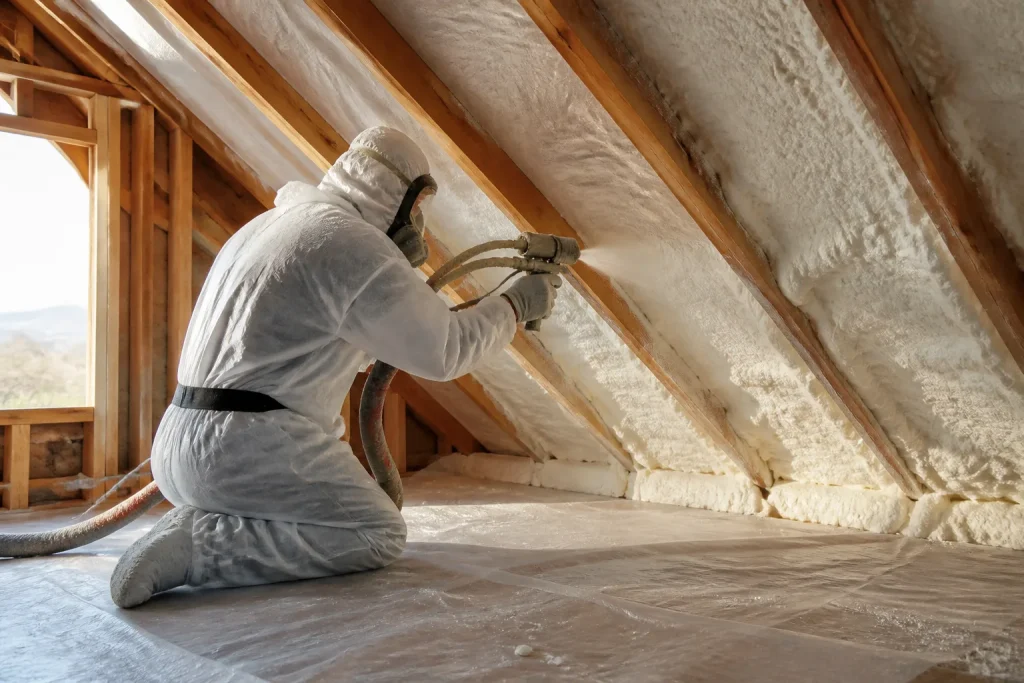
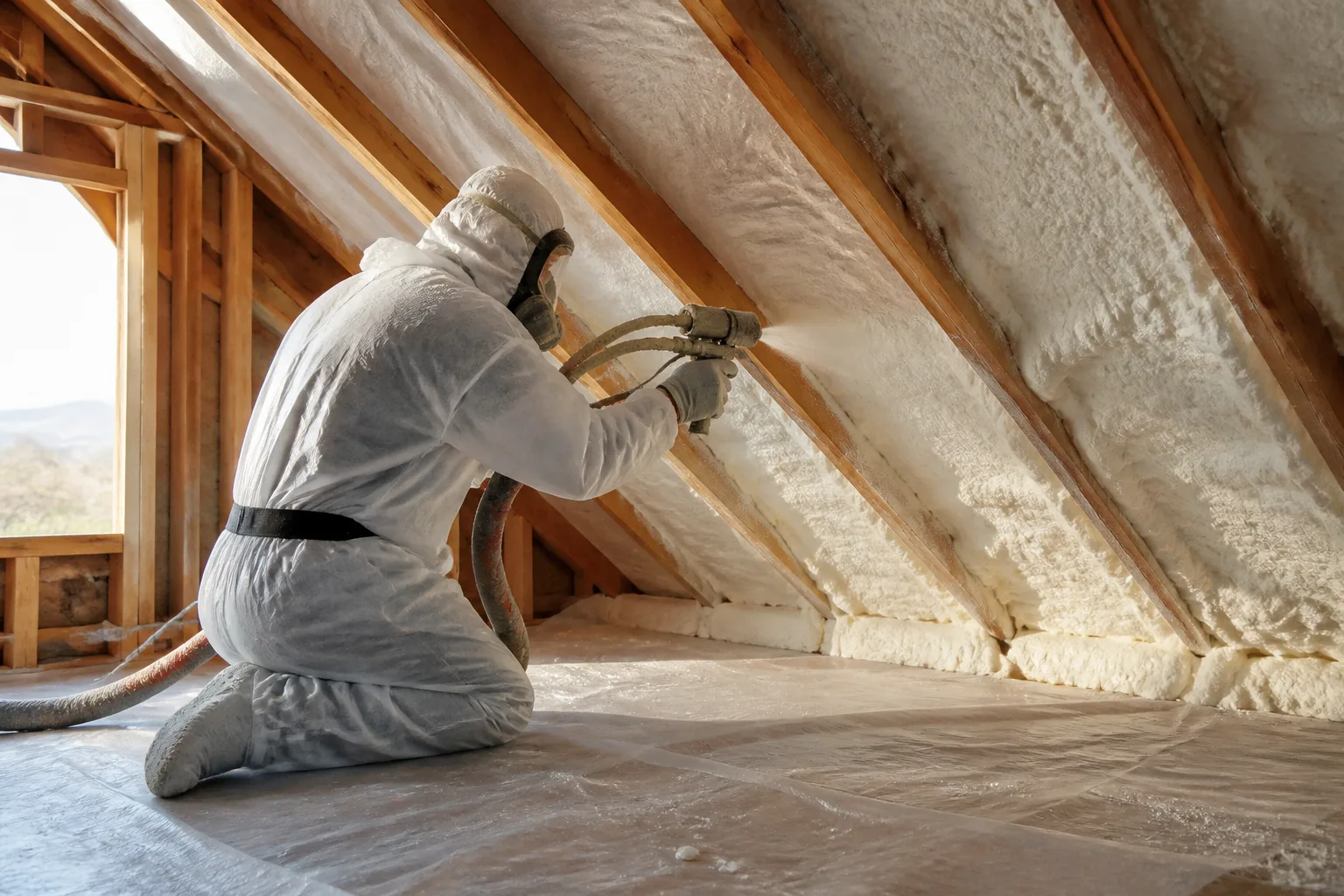
A 1,500-square-foot attic floor doesn’t mean 1,500 square feet of spray area. When you spray the roofline, the actual surface area includes the roof pitch, the gable ends, and any dormers or hips. A typical 1,500-square-foot single-story home in San Bernardino has a roofline spray area of 2,200 to 2,600 square feet. At 5.5 inches of open-cell foam, that’s 12,100 to 14,300 board feet. At San Bernardino pricing, that roofline job lands between $3,600 and $8,600 depending on foam type and prep.
If you’re comparing quotes and one contractor is dramatically cheaper, the first thing to check is the board-feet math. A quote that prices 1,500 square feet on a roofline job is pricing the floor, not the roof. That’s a classic lowball tactic. The crew shows up, realizes the actual spray area is nearly double, and you get hit with a change order before lunch. Or they spray thin, and you never know the difference until your first summer electric bill arrives.
For a visual reference, most legitimate spray foam quotes in San Bernardino will show a line item for estimated board feet. If the contractor won’t show you the math, that’s a red flag. We include it because the thickness decision drives both the material cost and the performance outcome.
If you live in an older San Bernardino neighborhood like the Westside or around Perris Hill Park, your framing is probably 2×4 with irregular spacing and decades of settling. That means more prep work, more gaps to fill, and potentially more board feet than a straightforward new build. The house tells you what it needs. The quote should reflect that, not a generic template.
The Hidden Costs That Inflate Final Invoices
Here’s where spray foam pricing in San Bernardino gets ugly. Every legitimate contractor has seen the quote that was $1,500 lower than everyone else, only to watch the final invoice come in $2,000 higher. It’s not a coincidence. It’s line-item strategy. The most common hidden costs are:
- Existing insulation removal. Blown fiberglass from 1985 has to come out before the foam goes on. Some quotes conveniently omit removal and let you discover it on install day.
- Surface prep and gap filling. Spray foam adheres to clean, dry substrates. Dirty roof decking, sawdust, loose nails, and framing gaps all need attention first. If the quote doesn’t mention prep, it’s not included.
- Re-inspection fees. In San Bernardino, building permits for insulation work require a city or county inspection. If the first inspection fails because the foam depth doesn’t match the spec, re-inspection fees come out of someone’s pocket.
- Waste and overspray material. Foam expands and trims back. Some overage is normal. A quote that assumes zero waste is cutting corners somewhere.
- Masking and protection. Spray foam sticks to everything. Protecting windows, floors, and the HVAC system takes time and plastic. If the quote doesn’t show it, the crew either skips it or charges later.
A legitimate San Bernardino spray foam quote breaks these out as separate line items. If you get a quote that’s just “spray foam, X square feet, one price,” ask the contractor to itemize. The response tells you everything. And if you’re in a home built before 1990 in the foothills, be prepared for old insulation that may contain asbestos in vermiculite form. That’s a removal project that requires remediation, not just a vacuum truck.
Is Closed-Cell Worth the Premium in San Bernardino?
Sometimes yes, usually no. San Bernardino’s climate is hot and dry. We don’t have the humidity battles that make closed-cell’s vapor barrier essential in Florida or coastal Texas. We also don’t have severe freeze-thaw cycles that stress framing. The structural rigidity story that closed-cell sells in hurricane zones just isn’t as urgent here.
However, closed-cell earns its premium in specific San Bernardino scenarios:
- Unvented attic conversions. If your ductwork and air handler live in the attic and you want to bring that space inside the building envelope, closed-cell at the roofline creates a true air and vapor barrier without adding venting complexity.
- Rim joist sealing in raised foundations. Older homes in the Warm Springs and Magnolia Center areas often have raised foundations with open rim joists. Closed-cell seals the rim better than open-cell and resists any ground moisture.
- Rooms over garages. If you have a bedroom above an unconditioned garage, closed-cell in the garage ceiling stops the hot air from the garage floor plate from cooking the floor above.
- Vaulted ceilings with no attic access. Some San Bernardino mid-century builds have vaulted ceilings with almost no cavity depth. Closed-cell packs more R-value into less space.
For a standard attic roofline or wall cavity job in San Bernardino, open-cell is usually the better financial move. It delivers the air sealing you need at roughly a third of the cost per R-value. The trick is making sure you actually get the thickness that was quoted. We pulled open-cell foam out of a garage on the north end of San Bernardino a few years back where a previous contractor had sprayed about two inches instead of the five that were quoted. The homeowner said the garage always felt fine. He didn’t realize the foam had never done its job. His cooling bill was doing the extra work instead.
And here’s a point worth making plainly: spray foam is not always the answer. If you have a vented attic with existing blown insulation that’s in decent shape, the smartest spend is usually blown-in insulation in San Bernardino to top off what’s already there. GreenFiber cellulose or mineral wool from Rockwool both handle San Bernardino’s heat load well without the spray foam price tag. The right move depends on your specific roofline and how your ducts are set up.
California Rebate Programs and Utility Incentives for 2026
San Bernardino homeowners can reduce spray foam costs through several programs, but the window matters. These rebate funds are finite and get claimed fast in the spring.
SCE (Southern California Edison) Home Energy Upgrade Program. In 2026, SCE continues to offer rebates for insulation upgrades that reduce cooling load. Rebate amounts are tiered based on the improvement percentage. Typical insulation projects qualify for $250 to $500 back, but air sealing and duct sealing upgrades can push the total higher.
SoCalGas Energy Savings Assistance Program. Income-qualified homeowners in San Bernardino County can receive insulation upgrades at no cost or heavily reduced cost through SoCalGas. The program covers attic insulation primarily, but some cases include wall cavity work. Qualification is based on household income and household size.
Federal 25C Tax Credit. Not California-specific but relevant. For 2026, the federal tax credit for insulation improvements remains at 30% of the material cost up to $1,200 per year. Spray foam materials qualify as long as they meet the IECC climate zone standards, and San Bernardino falls in climate zone 3B. Labor does not count toward the credit.
City of San Bernardino permit fees. When spray foam triggers a building permit, the city charges a fee based on project valuation. It’s rarely discussed in contractor quotes, but it’s on your final invoice. Legitimate contractors include it. If your quote says “permits included,” confirm the actual city fee is listed.
We always recommend homeowners check current SCE and SoCalGas program availability before signing a contract. Program budgets reset at different points of the year, and the rebates only apply if the installer is a participating contractor. As a spray foam insulation contractor in San Bernardino, we walk every client through the active rebate landscape before work starts. The rebate money comes to you, not us, so there’s no reason to leave it on the table.
What to Look for in a San Bernardino Spray Foam Quote
By now you can see why two quotes for the same house can differ by 40%. It’s rarely about one contractor being greedy and another being generous. It’s about what’s in the scope. Before you sign anything, make sure the quote includes:
- Estimated board feet, not just square footage
- Foam type (open-cell or closed-cell) and installed thickness
- R-value achieved at that thickness
- Surface prep and gap filling as a line item
- Existing insulation removal costs
- Permit fees and inspection costs
- Rebate paperwork and eligibility verification
- Payment schedule tied to milestones, not a large upfront deposit
We install insulation and nothing else. That’s not a tagline. It’s how we think about every job. The right material for your home is determined by what the house actually needs: spray foam where air sealing matters, blown-in where density and coverage matter, and batts where the framing calls for a straightforward cavity fill. We carry eight leading brands so you’re not limited to whatever we happened to order this week. But the brand is the last decision, not the first. The house comes first.
The Bottom Line
Spray foam in San Bernardino in 2026 costs more than blown insulation and less than a new roof, but the price you pay depends on choices that should be made deliberately, not by accident. Open-cell on the roofline solves most comfort problems in this climate for a reasonable price. Closed-cell earns its premium in garages, rim joists, and unvented attic conversions. The quotes that look too good to be true usually are, because someone skipped the prep, fudged the thickness, or priced the floor instead of the roof.
Your home holds the temperature you set. That’s the outcome that matters. If you’re in San Bernardino and want an honest breakdown for your specific house, give us a call at (855) 341-7856. Estimates are free, and you’ll get the board-feet math to review yourself whether you hire us or not.
Frequently Asked Questions
Yes, if you’re air sealing the roofline or a rim joist, because spray foam is the only insulation that does both insulating and air sealing in one step. In San Bernardino’s heat, the air sealing benefit is what lowers cooling bills. If the goal is just more R-value in a vented attic, blown-in insulation delivers better value per dollar. Call (855) 341-7856 and we’ll tell you which applies to your home before you spend anything.
Spray foam is priced per board foot, not per square foot, because thickness matters. Installed cost ranges from $1.80 to $3.20 per board foot for open-cell and $4.50 to $7.50 for closed-cell. For a typical wall cavity at 3.5 inches thick, open-cell runs about $0.70 to $1.10 per square foot of wall area. Exact pricing depends on your square footage and foam type, so call (855) 341-7856 for a free estimate specific to your home.
Yes, but prep matters more. Older homes throughout the San Bernardino Valley often have existing insulation that needs removal, dirty roof decking, settled framing, and sometimes knob-and-tube wiring that requires electrical work first. Foam can’t be sprayed directly over active knob-and-tube. The work is doable and we do it regularly across neighborhoods like the Westside and Arrowhead, but it’s not a same-day job.
It depends on what’s there. If the existing insulation is dry and correctly installed, topping off with blown-in insulation is always cheaper. If it’s wet, compressed, or pest-damaged, removal and replacement costs more upfront but saves more in energy bills. Spray foam only becomes the cheaper option when you need air sealing as part of the job, because it combines two tasks into one. Call (855) 341-7856 and we’ll assess your attic honestly.
Written by the team at Comfort Zone Insulation Co, serving San Bernardino since 2012.
Need Insulation Help?
Call Comfort Zone Insulation Co — licensed & insured, here with fast after-hours help in San Bernardino.
(855) 341-7856