
Johns Manville Spray Foam Insulation in San Bernardino: A Homeowner’s Guide
Johns Manville spray foam insulation in San Bernardino delivers a specific technical advantage most homeowners never hear about: dimensional stability that holds up under the Inland Empire’s brutal summer temperature swings, where attics routinely hit 140°F and nights drop 50 degrees or more. If you’re weighing insulation options and want the short version, JM’s closed-cell foams are a quietly strong pick for this climate. If you’d rather skip the research and talk it through, call us at (855) 341-7856 for a free estimate.
Here’s the thing about spray foam that nobody tells you. Brand loyalty in spray foam usually comes from contractors, not homeowners. Most crews run one brand, maybe two, and you get whatever foam is on the truck. You might assume all spray foam is basically the same, but the published specs tell a different story. In San Bernardino, where a summer day can swing from 98°F at 4 p.m. to 62°F by dawn, a foam’s ability to stay put against framing matters more than its initial R-value. That’s where Johns Manville earns its keep.
Key Takeaways
- Johns Manville closed-cell foam offers strong dimensional stability, which matters in San Bernardino’s extreme day-to-night temperature shifts.
- JM’s low-VOC formulations mean shorter re-occupancy windows after installation, a real advantage for occupied retrofits.
- Open-cell and closed-cell JM products serve different purposes; choosing the wrong one wastes money.
- Warranty coverage for JM foam depends on proper registration and working with an authorized installer.
- JM isn’t always the right call. In some San Bernardino homes, a blown-in or mineral wool approach makes more sense.
What Dimensional Stability Actually Means (And Why San Bernardino Tests It Harder Than Most)
Dimensional stability is a foam’s ability to keep its size and shape after curing. Every spray foam expands during application, then settles. A foam with poor dimensional stability can shrink slightly over time, pulling away from studs, rafters, and top plates. Even a 1% shrinkage means air channels form along the framing, and air sealing was the whole point of choosing foam in the first place.
Johns Manville publishes dimensional stability ratings on their closed-cell products that hold up under thermal cycling tests. Thermal cycling is when a material repeatedly heats and cools. San Bernardino does this to insulation harder than almost any SoCal market because our daily temperature spread is so wide. A foam that survives 40°F swings in a coastal climate faces 50°F to 60°F swings here, day after day, from June through September. We’ve opened walls in Comfort Zone Insulation Co home service calls across the city and seen foam that pulled away from studs within a decade. That’s a North Park or Del Rosa home losing conditioned air through half-inch gaps that shouldn’t be there.
When foam separates from framing, the fix isn’t a patch job. It’s a full removal and reinstall. The material cost difference between a foam with strong dimensional stability and one without is often a few hundred dollars. The labor to redo an entire wall cavity is thousands. This is one of those choices where the spec sheet genuinely predicts the lifespan.
JM’s Open-Cell vs. Closed-Cell: Which One Goes Where
Johns Manville makes both open-cell and closed-cell spray foam, and they are not interchangeable. Open-cell is lighter, roughly half an R per inch, and allows some vapor movement. It’s half the cost of closed-cell, but it absorbs water and has a spongy structure. Closed-cell is dense, around R-6.5 to R-7 per inch, and acts as a vapor barrier. It costs more but adds structural strength and rejects moisture.
For San Bernardino homes, the practical split looks like this:
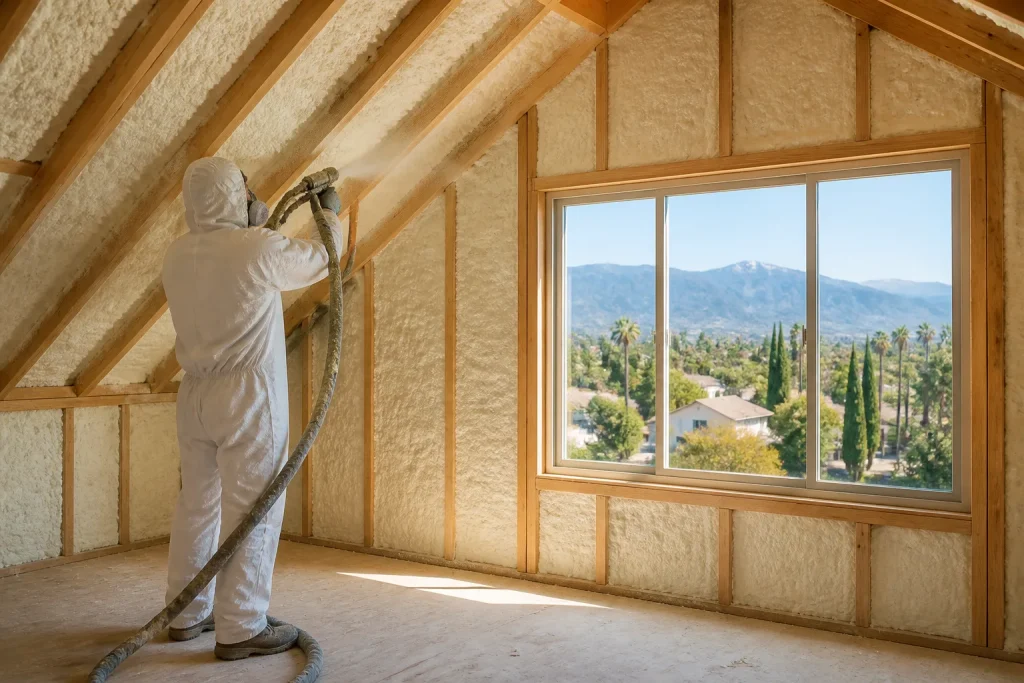
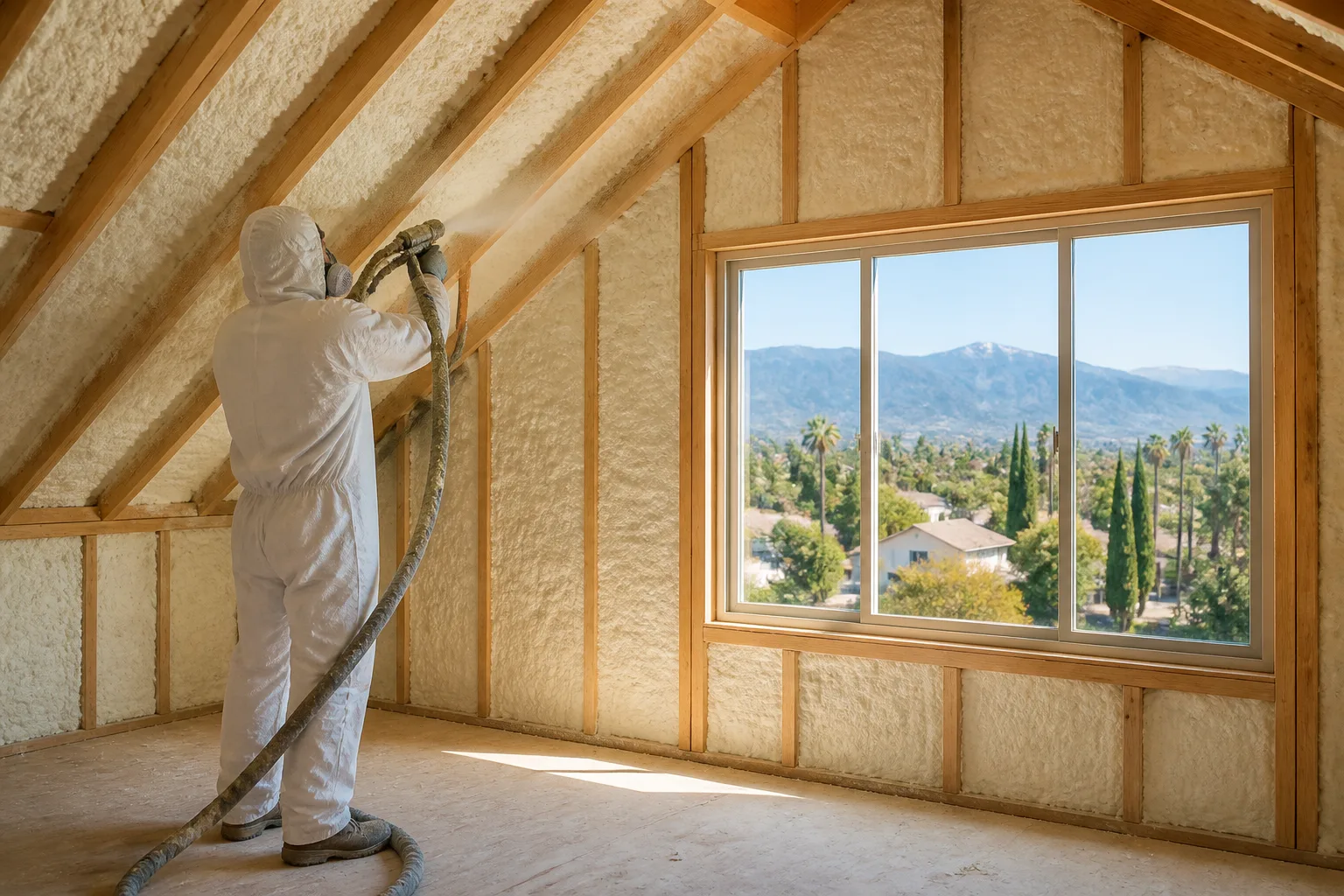
- Attic rooflines and unvented assemblies: Closed-cell often makes sense here because the attic is the single highest-impact insulation zone in a high-desert climate. We’ve measured 135°F attic temperatures in Verdemont in July. Closed-cell on the roofline keeps that heat from driving into the living space.
- Interior walls and sound control: Open-cell handles this well. You get air sealing plus noise reduction, and you’re not paying for moisture resistance you don’t need between bedrooms.
- Rim joists and crawl spaces: Closed-cell. These areas see moisture and temperature differentials where open-cell would underperform.
- Exterior wall cavities in older San Bernardino homes: Depends on the wall assembly. Homes built before the 1980s often lack a proper moisture control strategy. Here, a material-agnostic assessment matters because the wrong foam in the wrong wall can trap moisture where you don’t want it.
One note about timing. JM’s low-VOC formulation is a genuine practical benefit for homeowners doing occupied retrofits. Standard spray foam off-gasses for 24 to 72 hours after installation, and most manufacturers recommend staying out during that window. Johns Manville has invested heavily in reducing volatile organic compounds in their foam chemistry, which shortens the re-occupancy timeline. For a family in San Bernardino trying to live in their house during an insulation project, that’s not a marketing claim. That’s the difference between one night in a hotel and three.
How JM Foam Compares to What We Carry and When We Recommend Something Else
We install insulation and nothing else. That means we’re not married to one brand, and that’s actually the point. Comfort Zone Insulation Co carries products from eight manufacturers: Johns Manville, Owens Corning, Knauf, Rockwool, CertainTeed, Icynene, Demilec, and GreenFiber. The right material for your specific situation is the one that matches your home’s construction, your budget, and what you’re actually trying to fix.
Johns Manville spray foam competes most directly with Icynene and Demilec in the spray foam category. Icynene is heavily marketed and well-known. Demilec has strong closed-cell offerings. JM’s edge is the dimensional stability story and the VOC profile. If your concern is long-term adhesion under extreme temperature swings, JM closed-cell is a real contender.
But here’s where honesty matters. Spray foam is not always the right answer. If you have an attic with easy access, open framing, and a reasonable budget, a dedicated attic air sealing and insulation job in San Bernardino often delivers more comfort per dollar than foaming the entire roofline. If you’re in a stucco home with accessible wall cavities, dense-pack blown-in insulation from GreenFiber or Knauf can outperform spray foam in retrofit walls where foaming is impossible without opening drywall. And if fire resistance or sound control is the priority, a mineral wool product from Rockwool deserves a look. Johns Manville makes excellent spray foam. It does not make it the right foam for every San Bernardino home.
Warranty Documentation: What JM Requires and What You Should Keep
Johns Manville offers warranty coverage on their spray foam products, but it’s not automatic. The warranty applies when the product is installed by a JM-authorized contractor, and the homeowner needs to complete registration. Here’s what you should expect from any installer after a JM spray foam job in San Bernardino:
- A written product data sheet identifying the exact JM product installed, including whether it was open-cell or closed-cell and the nominal thickness applied in each zone.
- A JM warranty registration form completed with your name, property address, install date, and contractor information. If your installer doesn’t provide this, ask for it before final payment.
- Application coverage documentation showing depth measurements per cavity. JM’s warranty is tied to applied thickness meeting published spec. If a crew under-applies, the warranty won’t save you.
- A copy of the installer’s authorization to purchase and install JM products. JM restricts distribution to trained applicators, which protects you from foam that left the factory through the wrong channel.
We pulled a foam warranty claim out of a garage over in the Arrowhead Farms area last year where the original installer had vanished, the homeowner had no product data sheet, and the foam had shrunk badly in the south-facing wall. No documentation meant no claim. That’s a hard lesson, and it’s avoidable. Keep the paperwork. Register the warranty. Store both somewhere you’ll remember.
When to Call a Pro (And When Foam Isn’t Your Problem)
Spray foam application involves high-pressure equipment, heated chemical lines, and a reaction that generates significant heat during curing. This is not a DIY product. A bad foam job can leave voids behind drywall, off-ratio unreacted chemicals that off-gas for months, or insufficient coverage that delivers none of the air-sealing benefit you paid for. If you’re considering spray foam, work with a specialist who carries current manufacturer authorization.
Also worth considering: your comfort problem might not be insulation at all. San Bernardino homes built in the 1960s and 1970s often have attic bypasses, can lights leaking air, ductwork that’s disconnected, or bathroom fans venting into the attic. Adding foam on top of those problems just seals the problems in. A good diagnostic visit starts with finding the actual source of the discomfort before recommending any material. Related services we handle daily are spray foam insulation in San Bernardino, blown-in options for retrofit walls, and attic insulation as its own dedicated scope. The attic gets top billing because most comfort problems start at the top.
The Bottom Line
Johns Manville spray foam earns its place in San Bernardino for one specific reason: it holds up to the Inland Empire’s temperature cycling better than many more heavily marketed foams. That dimensional stability, combined with low-VOC chemistry and a solid closed-cell R-value, makes it a legitimate contender if you’re planning a roofline foam job or a moisture-sensitive cavity application. It’s not the right product for every home, and any contractor who says one brand always wins is selling you their inventory problem, not your solution.
If you’re in San Bernardino, Rialto, Colton, Highland, or the surrounding communities and want an honest read on whether JM foam, another spray foam line, blown-in, or an attic-focused approach fits your house, call us for a free estimate at (855) 341-7856. We’ll look at the actual assembly, not just the square footage. Your home holds the temperature you set. That’s the outcome we’re after.
Frequently Asked Questions
Closed-cell JM foam typically runs $2.50 to $4.50 per board foot installed in San Bernardino, while open-cell lands between $1.20 and $2.20 per board foot. A typical 1,500-square-foot attic roofline job runs $8,000 to $15,000 depending on depth and access. Closed-cell costs more up front but delivers nearly double the R-value per inch and acts as a vapor barrier. Open-cell is the budget-conscious air-sealing choice for interior and sound-sensitive zones. Call (855) 341-7856 for a specific quote on your home. Estimates are free.
JM closed-cell foam is a stronger choice when dimensional stability under extreme temperature swings is the priority, which applies to most San Bernardino attics and south-facing walls. Owens Corning and Icynene make excellent foams as well. The honest answer is that the installer matters more than the brand, and the specific application zone matters more than both. We carry eight brands specifically so the recommendation fits your house, not our supply order.
In most occupied retrofits, yes, though you’ll typically need to stay out of the home for 24 hours after application. JM’s low-VOC formulation shortens this window compared to some competing products, and your installer should give you a specific re-entry timeline based on the exact product applied, the volume of foam, and the ventilation setup. For large attic jobs, plan for one night elsewhere if you have any sensitivity to odors.
In correctly designed assemblies, no. Closed-cell foam acts as a vapor barrier, which works well in San Bernardino’s dry climate when applied to rooflines and rim joists. Problems arise when closed-cell is applied to the wrong side of a wall assembly or when an older home has pre-existing moisture issues that foam then seals in. This is why a material-agnostic assessment of the specific wall or roof assembly matters before choosing any foam product.
Written by the team at Comfort Zone Insulation Co, serving San Bernardino since 2012.
Need Insulation Help?
Call Comfort Zone Insulation Co — licensed & insured, here with fast after-hours help in San Bernardino.
(855) 341-7856