
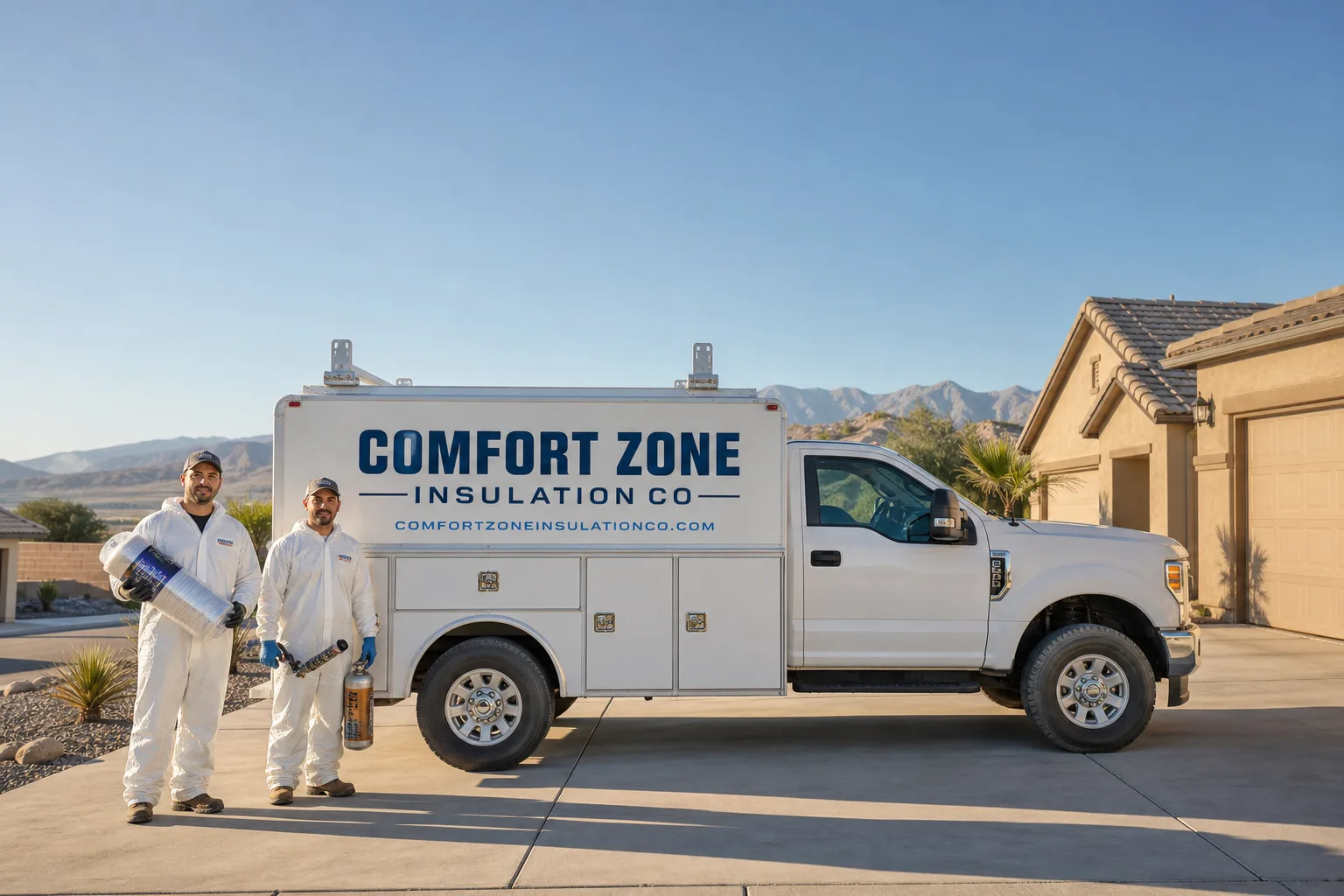
Fast, Reliable Attic Insulation Across San Fernando
Attic insulation in San Fernando is rarely a simple top-off job. Most homes here were built between the 1940s and 1960s, before insulation was standard, and what little original material went in has usually settled to almost nothing. We respond to San Fernando calls within one business day for quotes, and often same-week for installation. If your upstairs rooms bake after 2 PM and cool off only after midnight, your attic is telling you something. Call (855) 341-7856 and we’ll take a look.
We know San Fernando’s blocks off Maclay, Brand, and Truman: small stucco tract homes, shallow attics, dense lot lines. You need a crew that can navigate a tight side yard, work bilingually with older homeowners who prefer Spanish, and diagnose why one bedroom hits 90°F while the hallway stays fine. That’s the work we do every day.
Why Comfort Zone Insulation Co Is San Fernando’s Preferred Attic Insulation Company
We install insulation and nothing else. No remodels, no roofing side projects, no “we also do windows.” Our entire focus is what happens between your ceiling and your roof deck, which means when we inspect an attic in San Fernando, we’re looking for bypasses, settled fiberglass, blocked soffit vents, and heat-load patterns that general contractors routinely miss.
Our team is led by Noel Carrasco, who has spent years working specifically on San Fernando Valley housing stock. Noel knows the difference between a 1948 tract attic off Maclay and a 1970s infill off Paxton simply by the framing and the original insulation type. That matters because the fix is different. Homeowners across 91340 and 91341 have called us after other companies quoted full re-insulation when all they needed was a bare-center top-off and air sealing. We’d rather tell you the truth than sell you material you don’t need.
We also carry eight major brands, including Owens Corning, Rockwool, Knauf, and Icynene, so we’re never limited to whatever happened to be in stock this week. For a San Fernando homeowner, that means we can match the material to your specific attic: mineral wool if fire resistance matters, blown-in cellulose if you want recycled content, spray foam if your ductwork needs air sealing. The right material for your specific situation, not a brand we happen to push.
Attic Ventilation in San Fernando
Attic Ventilation in San Fernando is what keeps a 140°F attic from turning into a 150°F attic, and it’s the step most shortcuts skip. In San Fernando’s shallow tract attics, the ridge and soffit vents are often undersized or blocked, and once new insulation gets blown in, it can seal off the soffit vents entirely. That traps heat and moisture, which cooks your roof deck and makes your AC work harder. Proper ventilation means baffling the eaves before insulation goes in, checking the ridge vent or adding a solar-powered attic fan if your roofline needs it, and confirming air actually moves through the space.
Eave Baffles and Soffit Vent Protection
In a shallow San Fernando attic, the gap between the top plate and the roof deck can be six inches or less. Once you blow insulation to R-38 or R-49, that gap disappears unless baffles are installed first. Baffles keep a clear channel from each soffit vent up to the attic, so intake air keeps moving. Without them, the attic becomes a sealed oven.
When to Add a Powered Vent
Some San Fernando attics, especially on gable-roofed tract homes with no ridge vent, need mechanical help. A solar-powered or hard-wired attic fan can pull 1,000+ CFM when the sun is strongest, which is exactly when attics off Brand hit their peak. The cost of adding ventilation in San Fernando typically runs $150 to $600 depending on fan type and wiring, and it’s standard on most of our re-insulation jobs.
Radiant Barrier in San Fernando
Radiant Barrier in San Fernando is not a substitute for insulation, but it’s one of the highest-return additions for a Valley summer. A radiant barrier stapled to the underside of the roof rafters reflects radiant heat before it can soak into your attic air and push through your ceiling. In San Fernando, where summer highs routinely cross 100°F and attic temperatures exceed 140°F for hours at a time, a radiant barrier can drop attic temps by 10-15 degrees on its own. Paired with proper insulation and air sealing, it’s the difference between a back bedroom that stays at 78°F and one that climbs to 85°F by 4 PM.
Pairing Radiant Barrier with Blown-In Top-Offs
We see a lot of San Fernando homeowners who bought foil radiant barrier at a hardware store, stapled it up, and then wondered why the house didn’t get cooler. The answer is almost always the same: the attic center was bare. Radiant barrier cuts radiant heat gain, but if you have an inch of fiberglass at the eaves and nothing in the middle, conductive and convective heat still pour through the ceiling. The right sequence is baffles, air sealing, insulation to full depth, then radiant barrier. Radiant barrier itself runs about $0.75 to $1.50 per square foot installed in San Fernando, depending on whether it’s single- or double-sided and how accessible your rafters are.
When Radiant Barrier Is Worth It
Radiant barrier makes the most sense if you have south- or west-facing roof planes, which is a lot of San Fernando. The sun here doesn’t just heat the air; it beats directly on the roof deck hour after hour. If your attic has a steep pitch and enough room to work, installation is straightforward. If it’s a tight 4/12 pitch with framing every 16 inches, the labor goes up. Either way, it’s a real, measurable improvement, not a gimmick.
Trusted Brands We Service in San Fernando
We’re authorized to install products from eight industry brands, including Knauf, Rockwool, CertainTeed, and Icynene. For San Fernando’s housing stock, we lean on mineral wool from Rockwool when fire resistance and sound attenuation are priorities, Knauf blown-in fiberglass for deep top-offs in settled attics, and Icynene spray foam when the ceiling plane needs serious air sealing. Because we carry the full spectrum from fiber to foam, you’re not limited to whatever we happened to order this week. Your home holds the temperature you set, and the material under the hatch is the mechanism that makes that true.
Common Attic Insulation Problems We See in San Fernando Homes
- Settled builder-original blown-in fiberglass. In the 1940s-1960s tract homes off Maclay and Brand, the original fiberglass has compressed to one or two inches at the eaves while the center of the attic sits completely bare. A quick glance from the hatch looks fine; a walk-through tells a different story.
- Blocked soffit vents after a bad re-insulation job. Contractors who blow insulation without baffling the eaves first effectively seal the attic shut. The result is a hotter, more humid attic than before the work was done.
- Radiant barrier installed as a standalone fix. Foil alone cannot overcome a bare attic center. Without air sealing and a high-R cap, the Valley sun still drives attic temps past what foil can offset.
- Shallow attics with no access for inspection. Many San Fernando homes have attic hatches in a hallway closet and less than three feet of clearance at the peak. That doesn’t mean the work can’t be done; it means someone has to actually go up there and look, not quote from the driveway.
Noel Carrasco has walked dozens of these attics. We find what the last crew missed, and we fix it without overselling. If you’re in 91340 or 91341 and you suspect your attic is under-insulated, call (855) 341-7856 for a free inspection and exact quote.
Pricing for Attic Insulation in San Fernando, CA
Here’s what you can expect to pay in San Fernando, based on the jobs we actually do here. A bare-center top-off with air sealing and eave baffling on a 1,000-1,500 sq ft tract home typically runs $1,800 to $3,400. Full attic insulation replacement, where we remove the old material and start fresh, runs $3,000 to $5,500. Adding a radiant barrier to the roof rafters runs $750 to $1,800 depending on attic size and pitch. Attic ventilation work, including baffles or a powered fan, adds $150 to $600. Your exact price depends on square footage, attic depth, access, and the material you choose, but these are the ranges for San Fernando’s housing. Estimates are free, and we never charge for the inspection.
We Also Serve Cities Near San Fernando
Most of our San Fernando work is concentrated in the tract blocks around Maclay, Brand, and Truman, but we take calls across the northwest Valley. We regularly serve homeowners in North Hills, Shadow Hills, Northridge, and Van Nuys, often the same week. If you’re in one of those neighborhoods, call (855) 341-7856. For the full picture of what we do, see our Attic Insulation service page.
Serving San Fernando, CA — Our Local Coverage Area
We’re based in the San Fernando area and know this community well. Use the map below to see our service coverage — if you’re nearby, we can almost certainly help.
FAQs About Attic Insulation in San Fernando
Because the original blown-in fiberglass in 1940s-1960s tract homes off Maclay and Brand has settled over decades to a thin one-to-two-inch layer pinned at the eaves, while the center of the attic is completely bare. The edges hold what gravity left behind; the middle is where you lose all your cooling. The fix is usually a top-off with air sealing, not a full re-insulation. Call (855) 341-7856 and we’ll inspect it properly.
It makes sense if the attic center is already properly insulated and the roof sees direct sun, which most San Fernando roofs do. Radiant barrier alone won’t fix a bare attic, but paired with R-38 or higher insulation, it typically drops attic temperatures 10-15 degrees during the hottest hours. For most tract homes here, it’s a worthwhile add-on, not a standalone solution.
Rarely. Most San Fernando tract attics don’t need full removal. What they need is the settled original material assessed, the bare center topped off to R-38 or R-49, and the ceiling plane air-sealed so the new insulation actually functions. Full replacement is only worth it when there’s moisture damage, rodent contamination, or the original material has broken down to dust. A free inspection tells you which path applies.
By installing eave baffles before any insulation goes in. In shallow attics with limited clearance between the top plate and roof deck, baffles create a protected channel from each soffit vent up into the attic. Without them, blown-in insulation settles into the eaves and seals the attic shut, which makes it hotter and more humid than before. This is standard on every job we do in San Fernando.
Because San Fernando’s dense lot pattern and heavy Spanish-language homeowner base make word-of-mouth travel fast. When we finish a house off Truman, the neighbors have seen the truck, asked about the work, and often want the same fix. Our crew works bilingually, explains the job in Spanish or English, and we frequently move from one house to the next on the same block. It’s efficient for us and cheaper for homeowners.
Written by Noel Carrasco, Owner at Comfort Zone Insulation Co, serving San Fernando and the surrounding Valley since day one.