
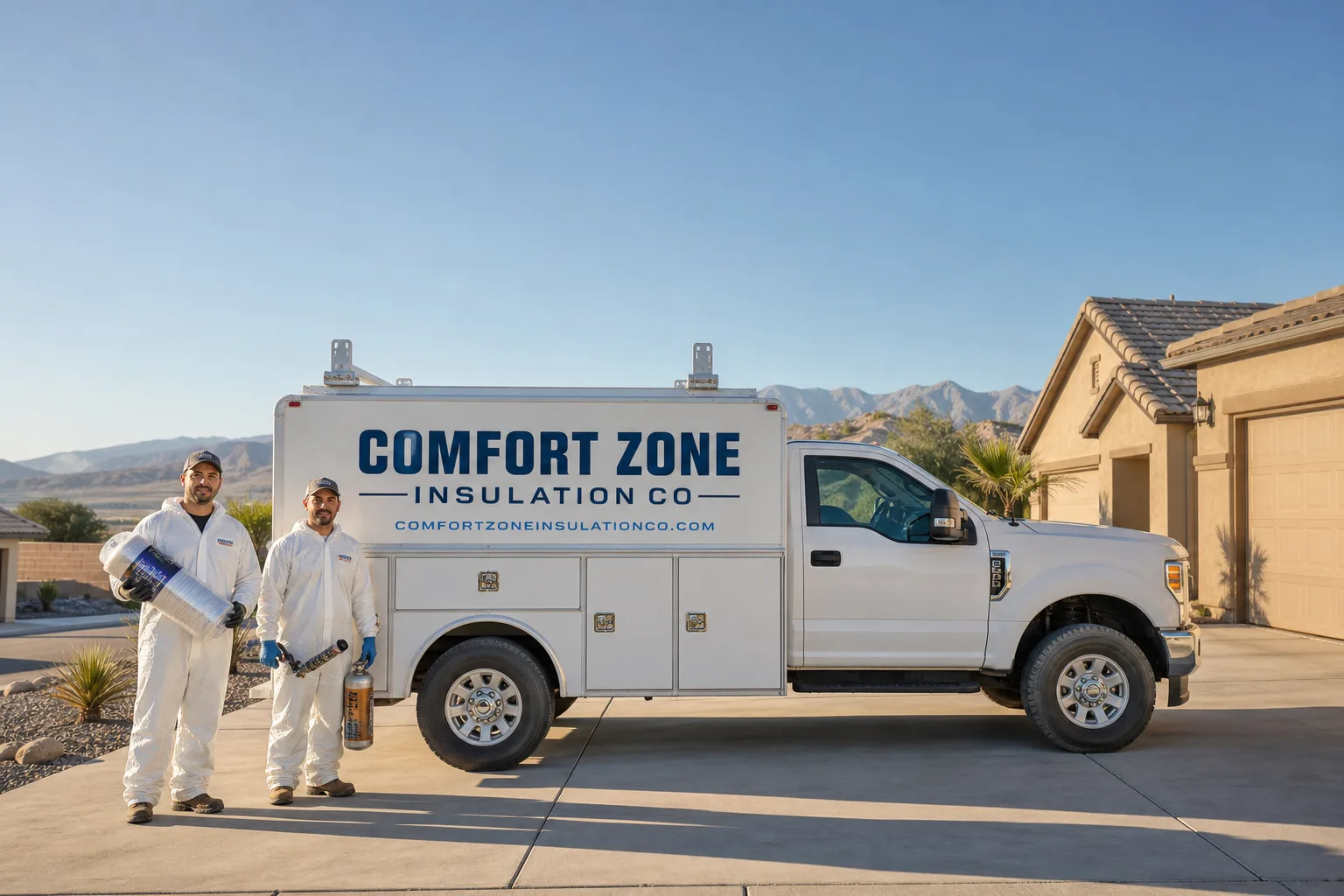
Fast, Reliable Attic Insulation Across Corona
Attic insulation in Corona has to do one job exceptionally well: hold back attic heat that regularly exceeds 150°F from July through October. Most Corona attics we inspect are under-insulated for that specific load, especially older homes around the Circle City core and properties along the Santa Ana Mountain foothills. We install attic insulation in Corona with materials matched to your home’s orientation, roof pitch, and existing ventilation. If your upstairs rooms run hot by 3 p.m. or your AC cycles constantly, call us at (855) 341-7856. We’ll diagnose the actual problem before recommending anything.
Why Comfort Zone Insulation Co Is Corona’s Preferred Attic Insulation Company
We install insulation and nothing else. That focus matters in Corona because attic work here rarely stops at adding R-value. Older homes in the 92882 and 92877 ZIPs need air sealing, vent baffling, and perimeter detailing, not just more material dumped over what’s already failing. Corona homeowners call us because we’re comfortable explaining why a south-facing bedroom runs hotter than the rest of the house, or why their ceiling stained after the first heat wave. Our crews know the difference between a Coronita tract home from 1978 and a newer two-story out near Eagle Glen, and we spec each one differently.
Noel Carrasco leads our Corona projects personally. Under his direction, our crew has handled everything from full attic insulation replacement in 1960s ranchers near the Circle City core to baffle-and-vent corrections in 92880 two-stories with cathedral ceilings. We carry materials from Owens Corning, Johns Manville, Knauf, Rockwool, CertainTeed, Icynene, Demilec, and GreenFiber, so your recommendation is based on what your attic actually needs, not what’s sitting on our truck. Estimates are free, and our Corona response window is same-week in most cases.
Insulation Contractors in Corona
Insulation contractors in Corona do more than blow fiber and walk away. A proper attic job here starts with diagnosing air movement: where conditioned air is escaping through can lights, top plates, bathroom fan housings, and the attic hatch. Then we assess what’s already up there, because in Corona that often means settled fiberglass batts from the 1970s that have flattened to half their original R-value. We also check for Santa Ana wind drift, which pushes loose fill toward gable vents and leaves bare bands along the west and south perimeter.
Cost-wise, a typical attic insulation top-up in a 1,200 to 1,800 square-foot Corona home runs $1,400 to $2,600 depending on existing depth and access. Full attic insulation replacement with air sealing usually falls between $3,200 and $5,800. Blown-in attic insulation for new construction or gutted remodels typically lands between $2,200 and $4,500.
Attic Top-Up and Re-Leveling
When Santa Ana winds drift loose fill toward the vents, the fix isn’t always adding more material. We rake back and re-level existing fill to a uniform depth, then re-detail the perimeter with fresh blown-in material or batt insulation at the eaves. This corrects the hot spots without over-insulating the middle of the attic.
Air Sealing Before You Insulate
In Corona’s older central tract homes, air leakage through the attic floor erases a surprising amount of insulation performance. We seal top plates, wire penetrations, and recessed light housings before we add insulation. Skipping this step means you’re paying to condition attic air.
Attic Ventilation in Corona
Attic ventilation in Corona has to work harder than in most Southern California cities because attic temperatures here spike higher and Santa Ana winds actively push air through gable vents. A poorly baffled gable vent doesn’t just fail to ventilate; it becomes a drift point that moves loose-fill insulation toward it. We see this constantly in Circle City homes: insulation piled deep near the vent, a bare band along the west-facing perimeter, and ceiling stains appearing after the first serious heat wave.
Attic baffle installation and ventilation prep in Corona typically runs $280 to $650 for standard soffit-to-gable correction on a single-story home. Full ventilation redesign, including adding ridge or eave venting to an older attic, ranges from $900 to $2,200 depending on roof complexity and access.
Gable Vent Baffling
In Corona, gable vent baffling is preventive maintenance, not an upgrade. A simple baffle keeps the vent open for air movement while blocking the wind path that carries loose fill toward it. We install these as part of nearly every attic top-up on homes built before 1990.
Eave and Perimeter Detailing
South- and west-facing attics along the foothills absorb more radiant heat than valley-floor homes. We detail eaves with baffles that keep insulation from blocking soffit vents, which preserves the convective airflow that pulls hot air out of the attic. It’s a small step with a big effect on how the upstairs feels by late afternoon.
Trusted Brands We Service in Corona
We stock materials from eight leading manufacturers so our Corona recommendations aren’t limited by what we happened to order that week. For blown-in attic insulation, we install Johns Manville and Knauf fiberglass, plus GreenFiber cellulose for homeowners who want recycled content. For batt work in older Corona attics, we use Owens Corning and CertainTeed. Rockwool works well for homeowners prioritizing fire resistance and sound attenuation, especially in foothill-adjacent areas with wildfire exposure. We’ll recommend the right material for your specific situation, not the one we’re most familiar with.
Common Attic Insulation Problems We See in Corona Homes
- Settled original batts in 1960s-1980s tract homes. Fiberglass from that era compresses over decades and loses roughly half its R-value. The attic can’t buffer 150°F heat anymore, and the upstairs begins to feel like an oven by mid-afternoon.
- Santa Ana wind drift pushing loose fill toward gable vents. Dry, hot wind enters through the vent and shoves loose fill inward, leaving bare perimeter bands. The first sign is often a faint ceiling stain along west or south walls after a heat wave, not an obvious gap.
- Foothill solar gain on south- and west-facing slopes. Homes along the Santa Ana Mountain foothills take ambient heat plus reflected radiant heat off the slopes. Standard valley-floor insulation specs don’t account for that extra load, and those bedrooms run noticeably hotter.
- Cathedral ceiling challenges in newer 92880 and 92883 two-stories. Complex rooflines leave little room for insulation depth, and poor detailing at the eave-to-ceiling transition creates heat bridges. These attics need careful air sealing and baffling before insulation is added.
Pricing for Attic Insulation in Corona, CA
Attic insulation pricing in Corona runs a bit higher than in Riverside or Ontario because older housing stock here needs more prep work: re-leveling drifted fill, correcting baffles, and air sealing before new material goes in. A basic blown-in top-up for a 1,200-square-foot attic starts around $1,400. Adding air sealing, vent correction, or perimeter detailing pushes that to $2,000 to $3,200. Full replacement on a 1960s or 1970s attic with original insulation typically lands between $3,400 and $5,800. Larger foothill homes with complex rooflines or cathedral ceiling sections can run higher; we’ll give you a fixed quote before any work begins. Call (855) 341-7856 for a free estimate.
We Also Serve Cities Near Corona
Our attic insulation crews serve Corona plus the surrounding communities of Attic Insulation in Corona neighbors Home Gardens, El Cerrito Corona, Eastvale, and Norco. If you’re just outside the city line, call us; we’re likely already working in your neighborhood. For more on our full service area and methods, see our Attic Insulation page.
Serving Corona, CA — Our Local Coverage Area
We’re based in the Corona area and know this community well. Use the map below to see our service coverage — if you’re nearby, we can almost certainly help.
FAQs About Attic Insulation in Corona
Corona sits at the base of the Santa Ana Mountains, where summer heat radiating off the foothills combines with intense afternoon sun to push attic temperatures higher than most inland cities see. Attics here can and do exceed 150°F during July and August. Add dry Santa Ana winds moving hot air through gable vents, and the attic becomes a solar collector with forced-air circulation. Call us at (855) 341-7856 for an attic assessment; we’ll measure what your insulation is actually holding back.
Original fiberglass batts in 1970s Corona homes settle and compress over decades, typically losing about half their rated R-value. Signs of failure include hot upstairs rooms by mid-afternoon, AC running constantly in summer, large temperature differences between upstairs and downstairs, and faint ceiling stains along the west or south perimeter. If your attic floor feels warm to the touch in summer, the batts are no longer doing their job. We can inspect and give you an honest read on whether top-up or full replacement makes more sense; estimates are free.
Yes. South- and west-facing foothill homes in Corona absorb additional radiant heat off the mountain slopes, especially in the late afternoon. That heat loads the attic from below and above, so the attic insulation strategy needs to account for both radiant gain and conduction. We also pay closer attention to eave baffling and perimeter detailing on these homes, because the solar load is highest exactly where air must keep moving. Call (855) 341-7856 and we’ll walk you through what’s different about your roofline.
Santa Ana winds push very dry, hot air through gable vents, and that airflow drifts loose-fill insulation toward the vent and away from the attic perimeter. The result is a bare band along the edges where heat pours in, and the first visible sign is often ceiling stains after the first heat wave rather than an obvious coverage gap. We correct this with gable vent baffling and re-leveling, not just more material. Call for an inspection if your west-facing rooms run hot.
Cathedral ceilings in newer Corona two-stories leave very little room for insulation depth, which means every inch has to perform. The tricky part is the transition where the ceiling meets the eaves; that’s where heat bridges form and where air sealing matters most. We detail those transitions carefully and use high-R-value materials that fit the available cavity. If your upstairs bedrooms in the 92880 or 92883 ZIP never seem to cool down, call (855) 341-7856; we’ll take a look and give you a straight answer.
Contact Comfort Zone Insulation Co in Corona
If your Corona attic is under-insulated, wind-drifted, or just not holding back the heat anymore, we’ll diagnose it properly and recommend the right material for your specific situation. We install insulation and nothing else, and we carry eight leading brands so you’re not limited to whatever happened to be on the truck. Call (855) 341-7856 for a free estimate today.
Written by Noel Carrasco, Owner at Comfort Zone Insulation Co, serving Corona and surrounding communities.